Myths Magic and Schema
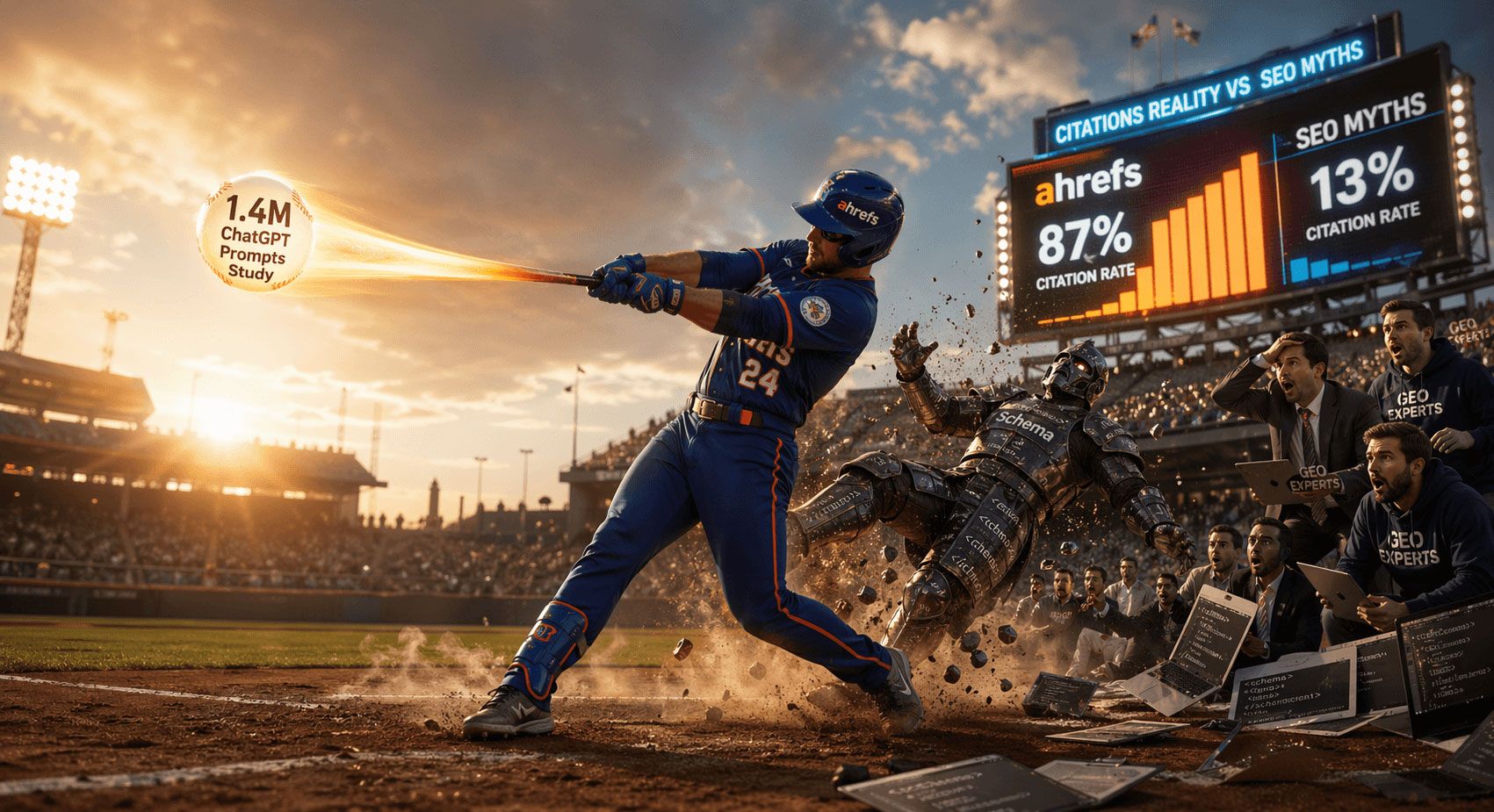
Ahrefs released a study in April 2026 that should have sent shockwaves through the SEO community. Instead, most people missed it entirely. The study examined which pages ChatGPT actually cites, and the findings are damning for anyone who has been chasing the schema markup myth.
The pattern is clear, and it validates everything we know about building genuinely useful content. ChatGPT does not cite based on hidden metadata. It cites based on relevance, clarity, and most importantly whether your page actually ranks in the search index.
The Gatekeeping Layer: Why Ranking Still Matters
Let us start with the most important finding. Eighty-eight percent of all ChatGPT citations come from the general search index. Not from Reddit API feeds, not from YouTube, not from academic databases. From search.
This is not new information, as the Ahrefs team themselves acknowledge. But it is nice to have data that crushes the hype. If you want to be cited by ChatGPT, you need to rank. Full stop.
The alternative retrieval channels Reddit (1.93% citation rate), YouTube (0.51%), Academia (0.40%) are pulled in at scale but barely ever make it into actual citations. ChatGPT uses them extensively to understand context and gauge consensus, but it almost never gives them credit.
This tells you something profound. ChatGPT learns from the crowd, then cites the institution. It reads what is visible and readable, then attributes authority to the pages that have already proven themselves through search ranking.
The gatekeeping layer is real. Before ChatGPT opens and reads your actual page content, it evaluates your title, URL, and snippet. If you do not pass that initial filter, your page may never be opened at all. Your content does not matter if nobody bothers to read it.
The Title is the Gatekeeper
Here is where it gets interesting. The Ahrefs study measured semantic similarity between page titles and the queries ChatGPT was trying to answer. The results were stark.
Cited pages had a semantic similarity score of 0.602 to the original prompt. Non-cited pages? 0.484. That is a meaningful gap.
But the real story emerges when you look at ChatGPT's internal 'fanout queries' the sub-questions it generates behind the scenes to hunt for specific facts. When you measure title relevance against those fanout queries, the gap widens dramatically. Cited pages scored 0.656; non-cited pages fell further behind.
In other words, your title is not just metadata. It is the first decision point. If your title does not semantically align with what ChatGPT is actually asking, you are already out of the game.
This is not about keyword stuffing. This is about clarity. About writing titles that actually communicate what your page is about. About making it easy for the machine to understand the human-facing content.
The study also found that pages with natural language URL slugs had an 89.78% citation rate, compared to 81.11% for opaque URLs. This reinforces the pattern: readability and clarity win. Hidden complexity loses.
SEO Stop chasing algorithmic ghosts. Build a foundation that withstands the agentic shift with clear, structured, and authoritative content.
Bookmark the SEO CanonWhy This Validates the Canon
Our SEO Canon is built on timeless principles: depth, accuracy, trust, and clear structure. This Ahrefs study is empirical proof that those principles still matter in the age of AI.
The Canon's pillar on Entity Search & Semantics emphasises that machines understand content better when it is explicitly structured and clearly communicated. The Ahrefs data confirms this. ChatGPT does not parse hidden schema; it evaluates the semantic relationship between your title and the questions it is asking.
The Canon's pillar on Content Depth and Quality insists that genuine usefulness is the foundation of visibility. The Ahrefs study shows that within a single retrieval set, older, more established pages tend to get cited over fresh content. Why? Because depth and authority matter more than recency.
The Canon's pillar on E-E-A-T (Expertise, Experience, Authoritativeness, Trustworthiness) is validated by the fact that ranking which is built on E-E-A-T signals is the primary predictor of citation. You cannot fake your way into ChatGPT's citations. You have to earn them through genuine authority.
The SEO Canon's foundation rests on primary source research. The Ahrefs study, whilst not a primary source, strengthens this foundational principle through independent validation. And now, as AI systems become the new layer of search, the same principles apply.
The Freshness Paradox: Relevance Still Does the Heavy Lifting
There is a common narrative in SEO that AI prefers fresh content. And in aggregate, that is true. ChatGPT cites URLs that are 458 days newer than Google's organic results.
But within a single retrieval set—the pages returned for a specific query the pattern is different. The median age of cited pages is around 500 days old. Some cited pages are over 2,700 days old. Meanwhile, non-cited pages are overwhelmingly very young.
This sounds counterintuitive, but both things are true at the same time. Across the broader population of AI citations, ChatGPT skews fresher. But within a given query, it cites the older, more established pages.
Why? Because relevance still does the heavy lifting. A new page that matches ChatGPT's internal fanout queries well will get cited. A new page that does not will be retrieved, yet ignored.
Freshness is a tiebreaker. When two pages have similar relevance scores, the fresher one wins. But when relevance differs, relevance wins every time.
This is exactly what the Canon teaches. Build genuinely useful content first. Optimise for freshness second.
Reddit: The Textbook Nobody Admits Reading
Perhaps the most striking finding in the Ahrefs study is what happens with Reddit. ChatGPT retrieves Reddit content at scale over 16 million data points in the study. Yet it cites Reddit at a rate of just 1.93%.
In other words, ChatGPT uses Reddit extensively to understand topics, gauge consensus, and build context. But it almost never gives Reddit the credit.
This tells you something crucial about how AI systems work. They are not parsing structured data. They are not respecting semantic markup. They are reading what is visible and readable, extracting the information, and then attributing authority to pages that have already proven themselves through traditional ranking signals.
ChatGPT learns from the crowd, then cites the institution. It reads the discussion, then links to the authority.
This is the same pattern we saw in our earlier article on structured data and AI crawlers. AI systems tokenise the entire page including schema markup as plain text. They extract visible, readable content. They do not parse hidden metadata.
The Ahrefs study provides another layer of evidence. ChatGPT uses Reddit's visible content to understand context, but it does not cite Reddit because Reddit does not rank. Authority comes from ranking. Ranking comes from E-E-A-T signals, not from schema markup.
What This Means for Your Strategy
If you have been over-investing in schema markup whilst neglecting clear, readable structure, the Ahrefs data should be a wake-up call.
Your title needs to be semantically relevant to the questions your audience is asking. Your URL needs to be human-readable. Your content needs to be deep, authoritative, and genuinely useful.
Rank first. Optimise for relevance second. Add schema markup as a supporting signal, not a primary lever.
This is not a new strategy. It is the same strategy the Canon has always advocated. But now, with 1.4 million data points backing it up, it is harder to ignore.
The sites that win in 2026 and beyond will be those that remain genuinely useful. Not those chasing the latest markup trend. Not those relying on hidden metadata. Not those pretending that schema is the answer.
Build for humans with machine-readable clarity as a natural byproduct. That is the conduit to actual value.
References
[1] Linehan, L., Guan, X., & Law, R. (2026, April 15). Why ChatGPT Cites One Page Over Another (Study of 1.4M Prompts). Ahrefs Blog. https://ahrefs.com/blog/why-chatgpt-cites-pages/
[2] Ryall, P. (2026). Structured Data & AI Crawlers in 2026: Why Most Schema Hype Is Misplaced. Patrick Ryall SEO Canon. https://patrickryall.com/structured-data-ai-crawlers-2026
[3] Petrovic, D. Research on ChatGPT's retrieval pipeline and citation mechanisms.
[4] McSweeney, D. Research on ChatGPT's retrieval process and snippet field handling.