
A single-truth, evergreen resource built exclusively from primary sources
Why This Resource Exists in 2026
- To cut through the daily flood of "AI-first rules," GEO tricks, and hot takes
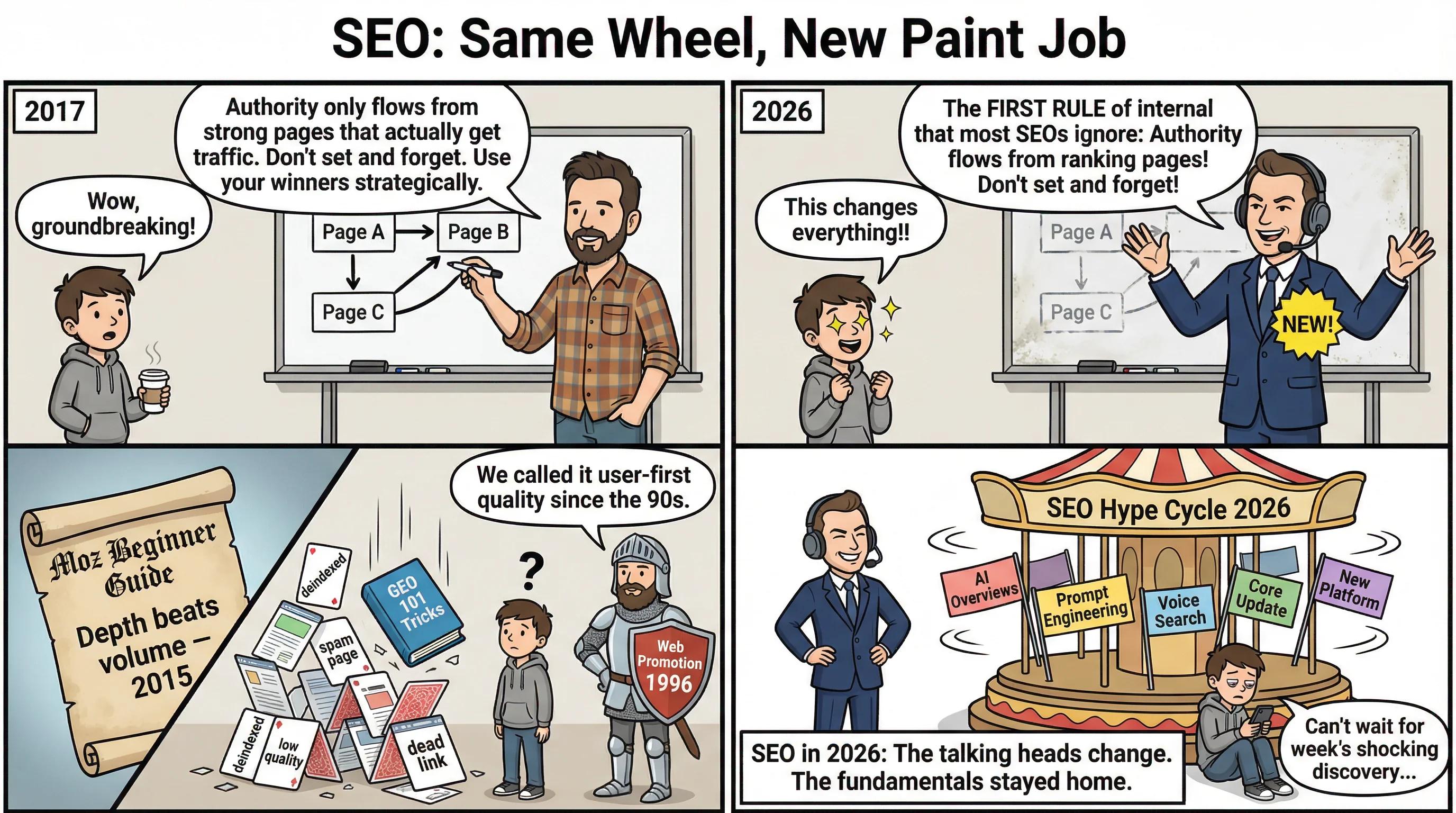
- To show that most "new" advice is often 10-25-year-old wisdom wearing fresh branding
- To provide a central home for new primary source material to grow the knowledge hub
- To give newcomers and veterans the exact quotes, original sources, and video context from the people who actually built the foundations
- To remind everyone: build for humans first; the engines (and AI systems) will follow
The Builders – The Voices Who Drew the Map
These individuals represent the collective wisdom that has guided SEO since before Google existed in its current form. Their work spans forums, patents, journalism, education, and direct engine communication.
Rand Fishkin, Moz co-founder and creator of Whiteboard Friday. Turned complex ideas into clear, visual education that remains the most referenced body of SEO teaching.
Signature contribution: Making strategic internal linking, content quality, and intent matching accessible to everyone.
Barry Schwartz, Founder of Search Engine Roundtable (2006-present) and the industry's archivist. Has documented nearly every algorithm change, leak, and pioneer discussion for two decades.
Signature contribution: Showing that the fundamentals don't change, only the acronyms do.
Danny Sullivan, Founded Search Engine Land and served as one of the earliest independent SEO journalists (active since 1996). Now a key voice at Google, still the trusted bridge between the industry and the engine.
Signature contribution: Repeatedly clarifying that quality content, user experience, and intent satisfaction are what matter, regardless of whether results appear as ten blue links or AI overviews.
Ammon Johns (The Black Knight), Cre8asite Forums founder and web-promotion philosopher since 1996. Reframed SEO as user-first marketing rather than manipulation.
Signature contribution: "I don't do SEO. I do web promotion... Focus on the customer/user first." [5]
Bill Slawski (1961-2022), Patent-analysis pioneer who systematically decoded Google's patents and explained entity-based search, intent layers, and semantic understanding years before they became mainstream.
Signature contribution: Teaching SEOs to think in concepts and confidence scores rather than isolated keywords.
Bruce Clay, Widely regarded as the "Father of SEO." In the industry since the early 1990s; created some of the first formal SEO methodologies and training programs.
Signature contribution: "Build for users, not for search engines, everything else is tactics." [6]
Gary Illyes, Google Webmaster Trends Analyst and the self-proclaimed "Chief of Sunshine and Happiness." He clarified the inner workings of Googlebot, Caffeine, and how the engine actually crawls the web.
Signature contribution: Demystifying crawl budget and indexation, proving that technical SEO is about removing friction for the bot.
John Mueller, Google's Senior Webmaster Trends Analyst and Search Relations lead. The constant voice of reason translating complex engineering into actionable webmaster guidance.
Signature contribution: Constantly reminding webmasters that technical perfection is not a ranking factor, but a prerequisite for being understood.
Lily Ray, SEO Director and one of the most authoritative voices on E-E-A-T, algorithm updates, and content quality in modern search. Known for cutting through industry noise with evidence-backed analysis and a sharp focus on trust signals.
Signature contribution: Defining how credibility, reputation, and real-world expertise shape rankings, and calling out the rise of low-value "AI slop" diluting the web.
The sections below draw directly from their collective writings, videos, forum posts, and documented statements. Each pillar includes what they said, why it is still 100% relevant in 2026, and what they never said.
1. Internal Linking & Authority Flow
What the builders said
"Authority only flows from pages that actually have authority... The linking page's importance affects influence."
, Rand Fishkin, Moz Whiteboard Friday, 27 September 2017 [1]
Ammon Johns and Bruce Clay both emphasised that internal links are one of the few things you completely control and should be used strategically from your strongest pages.
Why this is still 100% relevant in 2026
Google's crawl budget remains finite. AI Overviews and generative engines still rely on the same link-graph and crawl signals. Sites that spray automated internal links or accumulate thousands of low-value/orphan pages continue to see crawl efficiency and rankings suffer. The 2026 podcast claiming "The First Rule of Internal Linking that Most SEOs Ignore" is essentially restating Rand's 2017 whiteboard.
What they never said
"Just add more internal links everywhere."
"Automate everything and forget it."
"Anchor-text stuffing site-wide is harmless."
Practical application today
Identify your true authority pages via Search Console (traffic + rankings), then manually link from them to high-potential "striking distance" pages. Revisit quarterly. This practise still moves more rankings than most new tactics.
PageRank & Link Equity Mechanics
Primary Sources: Sergey Brin & Lawrence Page — "The Anatomy of a Large-Scale Hypertextual Web Search Engine" (1998) | Google Search Central — Link Best Practices | Rand Fishkin, Moz
The entire architecture of Google Search was built on a single insight: a link from one page to another is a vote of confidence. The more votes a page receives, and the more authoritative the pages casting those votes, the more important the page is. This is PageRank. It is not a metaphor. It is the literal mathematical foundation on which Google was built, and it remains one of the most powerful ranking signals in the system today.
What the Builders Actually Said
In their 1998 paper, Sergey Brin and Lawrence Page described PageRank with precision:
"We assume page A has pages T1...Tn which point to it. The parameter d is a damping factor which can be set between 0 and 1. We usually set d to 0.85. Also C(A) is defined as the number of links going out of page A. The PageRank of a page A is given as follows: PR(A) = (1-d) + d (PR(T1)/C(T1) + ... + PR(Tn)/C(Tn))"
— Brin & Page, "The Anatomy of a Large-Scale Hypertextual Web Search Engine," 1998
The formula encodes three things: the number of links pointing to a page, the authority of the pages doing the linking, and a damping factor that models the probability of a random web user continuing to click links rather than starting a new session. Every link on the web passes a fraction of the linking page's authority to the destination.
Google's current link documentation states:
"Google uses links as an important factor in determining the relevancy of web pages. Links help our crawlers find your site and can give your site greater visibility in our search results."
— Google Search Central, Link Best Practices
The Damping Factor and Link Dilution
The damping factor (d = 0.85) means that each link passes approximately 85% of its PageRank value. But that value is divided equally among all outbound links on the page. A page with 100 outbound links passes 0.85% of its PageRank through each link. A page with 5 outbound links passes 17% through each.
This is why internal linking architecture matters. Every time you add a link to a page, you dilute the value passed through every other link on that page. Every orphan page — a page with no internal links pointing to it — receives no PageRank from the rest of the site, regardless of how many external links the domain has.
Rand Fishkin documented this extensively in his Moz Whiteboard Friday series, demonstrating that sites with poor internal linking architecture were effectively "wasting" the link equity they had earned through external links by failing to distribute it to the pages that needed it most.
What They Never Said
The original PageRank paper never said that all links are equal. It never said that the number of links matters more than their quality. It never said that links from low-authority pages are worthless — they contribute, just less.
Google's documentation has never said that PageRank is the only ranking signal. It is one of hundreds. But it is the foundational signal — the one that determines the baseline authority of a page before any other signals are applied.
Google has also never said that PageRank is publicly visible. The public PageRank toolbar was discontinued in 2016. The internal PageRank score continues to operate but is not disclosed. Any tool claiming to show you a page's "PageRank" is showing you a proxy metric, not the actual score.
The nofollow Evolution
Google introduced the rel="nofollow" attribute in 2005 to allow publishers to link without passing PageRank — originally designed to combat comment spam. In 2019, Google updated its guidance, introducing rel="sponsored" for paid links and rel="ugc" for user-generated content, and reclassifying nofollow as a hint rather than a directive.
"All the link attributes — sponsored, ugc, and nofollow — are treated as hints about which links to consider or exclude within Search. Google will use these hints — along with other signals — as a way to better understand how to appropriately analyze and use links within our systems."
— Google Search Central, Qualify Your Outbound Links to Google
This is a significant clarification: nofollow links are not guaranteed to pass zero PageRank. They are hints that Google may or may not follow.
Why This Is Still 100% Relevant in 2026
PageRank has not been replaced. It has been supplemented. The introduction of AI Overviews, entity understanding, and semantic search has added new dimensions to how Google evaluates content, but the authority signal derived from links remains foundational. Sites with strong link profiles rank better, all else being equal.
The practical implication for 2026 is that link equity is now distributed across a more complex system. A link from a page that is itself cited in AI Overviews carries additional signal value. A link from a page with strong entity associations in Google's Knowledge Graph carries more weight than a link from a topically unrelated page.
Practical Application
Understanding PageRank changes how you think about both internal and external links. Internally, you map your site's link architecture to ensure that PageRank flows from your strongest pages to your most important conversion pages. You eliminate orphan pages. You reduce unnecessary links on high-authority pages to concentrate the equity they pass.
Externally, you focus on earning links from pages that themselves have strong link profiles — not just from sites with high domain authority scores, which are proxy metrics, but from pages that are themselves well-linked and topically relevant.
Primary Source Documentation
| Source | Type | URL |
|---|---|---|
| Brin & Page — The Anatomy of a Large-Scale Hypertextual Web Search Engine | Academic Paper (1998) | https://research.google/pubs/the-anatomy-of-a-large-scale-hypertextual-web-search-engine/ |
| Google Search Central — Link Best Practices | Official Documentation | https://developers.google.com/search/docs/crawling-indexing/links-crawlable |
| Google Search Central — Qualify Outbound Links | Official Documentation | https://developers.google.com/search/docs/crawling-indexing/qualify-outbound-links |
| Rand Fishkin — Moz Whiteboard Friday (Internal Linking) | Expert Practitioner | https://moz.com/blog/whiteboard-friday |
2. Crawlability & The Googlebot Reality
What the builders said
Primary Source Documentation
Source: Google Search Central Blog - "What Crawl Budget Means for Googlebot"
Author: Gary Illyes, Crawling and Indexing teams (January 16, 2017)
Official URL: https://developers.google.com/search/blog/2017/01/what-crawl-budget-means-for-googlebot
Key Definitions from the Source:
"Taking crawl rate and crawl demand together we define crawl budget as the number of URLs Googlebot can and wants to crawl." [2]
The 6 Crawl Budget Killers (in official order of significance):
- Faceted navigation and session identifiers
- On-site duplicate content
- Soft error pages
- Hacked pages
- Infinite spaces and proxies
- Low quality and spam content
The Critical Insight:
"Wasting server resources on pages like these will drain crawl activity from pages that do actually have value, which may cause a significant delay in discovering great content on a site."
"The topics in this section describe how you can control Google's ability to find and parse your content in order to show it in Search and other Google properties, as well as how to prevent Google from crawling specific content on your site."
, Google Search Central Documentation
Gary Illyes has spent years explaining that crawling is a resource-intensive process. A site must earn its crawl budget. John Mueller consistently reminds webmasters that technical perfection is not about ticking boxes; it is about removing friction. If a site is difficult to crawl, the engine will simply move on.
Why this is still 100% relevant in 2026
The plumbing of the internet is not glamorous, it is not a 'growth hack', but it is the absolute ground zero of visibility. If the engine cannot find your content, read your content, and understand your content, your content does not exist. With the explosion of AI-generated content, the web is noisier than ever, making efficient crawling paramount.
What they never said
"Submit every single URL to Search Console manually."
"A perfect robots.txt file guarantees high rankings."
"Googlebot will eventually figure out your messy architecture if your content is good enough."
Practical application today
Audit your log files to see what Googlebot is actually doing. Use robots.txt to keep crawlers out of infinite faceted navigation. Ensure your XML sitemap only contains your pristine, 200 OK, canonical URLs. It is a map of your best work, not a dump of your database.
Site Architecture & Information Architecture
Primary Sources: Rand Fishkin, Moz — Whiteboard Friday (Site Architecture) | Bruce Clay — SEO Best Practices (Site Architecture) | Ammon Johns — Web Promotion Philosophy | Google Search Central — Site Structure Guidelines
Site architecture is the skeleton of your website. It determines which pages Google can find, how much authority each page receives, and how clearly Google can understand the topical relationships between your content. A site with excellent content but poor architecture will consistently underperform a site with good content and excellent architecture. This is one of the most consistently underestimated factors in SEO.
What the Builders Actually Said
Rand Fishkin introduced the concept of "crawl depth" as a practical framework for understanding how site architecture affects SEO. His core observation, documented across multiple Moz Whiteboard Friday sessions, was that pages buried deep in a site's architecture — requiring many clicks to reach from the homepage — receive less PageRank and are crawled less frequently than pages closer to the surface.
The principle he articulated is now foundational:
"Every additional click away from your homepage reduces the PageRank that page can receive. If your most important content is five clicks deep, you are structuring your site to tell Google it is not important."
— Rand Fishkin, Moz Whiteboard Friday
Bruce Clay, one of the earliest SEO practitioners, contributed the concept of "siloing" — organising site content into thematic clusters where pages within a topic area link to each other but are carefully controlled in their links to other topic areas. The goal is to create clear topical signals that help Google understand what each section of a site is about.
Ammon Johns extended this thinking into what he called "web promotion philosophy" — the idea that a site's architecture should reflect the genuine hierarchy of value it provides to users, not the hierarchy that seems most likely to rank well. A site built for users will naturally develop an architecture that search engines can understand and trust.
The Flat vs. Deep Architecture Debate
The practical question in site architecture is always: how many clicks should it take to reach any page from the homepage?
The general principle, supported by Google's own crawl budget documentation, is that important pages should be as few clicks as possible from the homepage. For most sites, this means a maximum of three to four clicks for any page you want Google to crawl and rank regularly.
Google's documentation on crawl budget states that Googlebot prioritises pages that are more prominently linked from the rest of the site. A page that is linked from the homepage, the main navigation, and multiple internal content pages will be crawled more frequently and will receive more PageRank than a page that is only linked from one deeply buried category page.
Topical Clusters and Content Hubs
The evolution of site architecture thinking in the 2020s has been driven by Google's increasing sophistication in understanding topical authority. A site that covers a topic comprehensively — with a main pillar page and multiple supporting pages that explore subtopics in depth — signals to Google that it is a genuine authority on that topic.
This is not a new idea. It is the logical extension of Bruce Clay's siloing concept applied to content strategy. The difference is that modern topical clusters are built around user intent rather than keyword categories. The pillar page answers the broad question. The cluster pages answer the specific questions that arise from it. The internal links between them create a navigable, logical structure that both users and crawlers can follow.
What They Never Said
None of the practitioners who developed site architecture theory ever said that architecture alone is sufficient for ranking. Architecture is the foundation that allows your content and link equity to work effectively. Without good content and genuine authority, even a perfectly structured site will not rank for competitive queries.
They also never said that a flat architecture is always better than a deep one. For very large sites — e-commerce sites with hundreds of thousands of product pages, for example — a flat architecture is impossible. The goal is not flatness but clarity: every page should be reachable through a logical, predictable path.
Why This Is Still 100% Relevant in 2026
The shift to AI-generated search results has made site architecture more important, not less. AI systems that crawl and index content for retrieval-augmented generation (RAG) follow the same basic principle as Googlebot: they prioritise content that is clearly structured, logically organised, and easy to navigate. A site with clear architecture is easier for AI systems to parse and extract information from.
Furthermore, as Google's understanding of topical authority has deepened, the relationship between site architecture and topical relevance has become more direct. A site that organises its content into clear topical clusters sends stronger topical authority signals than a site where content is scattered without clear thematic organisation.
Practical Application
A site architecture audit starts with a crawl. Tools like Screaming Frog or Sitebulb map the link structure of a site and reveal pages that are too deep, pages with no internal links, and pages that are linked from too many places (diluting the signal of what is important).
The key metrics to evaluate are: click depth from the homepage for each important page, the number of internal links pointing to each page, and the topical coherence of the pages that link to each other. Pages that are important for business or SEO purposes should be promoted in the architecture — given more internal links, placed in the navigation, or linked from the homepage.
Primary Source Documentation
| Source | Type | URL |
|---|---|---|
| Google Search Central — URL Structure Guidelines | Official Documentation | https://developers.google.com/search/docs/crawling-indexing/url-structure |
| Google Search Central — Crawl Budget | Official Documentation | https://developers.google.com/search/docs/crawling-indexing/large-site-managing-crawl-budget |
| Rand Fishkin — Moz Whiteboard Friday (Site Architecture) | Expert Practitioner | https://moz.com/blog/whiteboard-friday |
| Bruce Clay — SEO Best Practices | Expert Practitioner | https://www.bruceclay.com/seo/seo-best-practices/ |
Algorithm Updates & Core Updates
Primary Sources: Google Search Central — Core Updates Documentation | Barry Schwartz, Search Engine Roundtable | Danny Sullivan, Google Search Liaison
Google has run automated ranking systems since its inception. But several times a year, it makes what it calls "core updates" — broad, significant changes to how those systems evaluate and rank content across the entire web. Understanding what these updates are, and what they are not, is one of the most misunderstood areas in SEO.
What Google Actually Said
Google's own documentation states this plainly:
"Core updates are designed to ensure that overall, we're delivering on our mission to present helpful and reliable results for searchers. These changes are broad in nature, and don't target specific sites or individual web pages."
— Google Search Central, Core Updates Documentation
The restaurant analogy Google uses is instructive: imagine a friend asks for your top 20 restaurant recommendations. You wrote that list in 2019. Now it's 2026. New restaurants have opened. Your tastes have evolved. Some places have declined. Updating the list doesn't mean any restaurant "did something wrong" — it means the landscape changed and your assessment of it changed with it.
Danny Sullivan, Google's Search Liaison, has been consistent on this point across years of public communication: a drop after a core update is not a penalty. It is a re-evaluation. The sites that replaced you were not rewarded for doing something clever. They were determined to be a better answer for the query under the new weighting.
The Helpful Content System
In August 2022, Google introduced what it called the "Helpful Content Update" — a site-wide signal designed to identify content created primarily for search engines rather than people. Unlike a core update, which is a broad re-weighting, the Helpful Content System generates a persistent signal that can suppress an entire domain if a significant portion of its content is deemed unhelpful.
Google's documentation is explicit about what this system looks for:
"Google's automated ranking systems are designed to prioritize helpful, reliable information that's created to benefit people, and not content that's created primarily to gain search engine rankings."
— Google Search Central, Creating Helpful, Reliable, People-First Content
The system evaluates whether content demonstrates first-hand expertise, whether it was created for a specific audience, and whether it leaves users feeling satisfied or sends them back to search for a better answer.
What Google Never Said
Google never said that core updates are reversible through quick fixes. Its documentation explicitly warns against this:
"Avoid doing 'quick fix' changes (like removing some page element because you heard it was bad for SEO). Instead, focus on making changes that make sense for your users and are sustainable in the long term."
— Google Search Central, Core Updates Documentation
Google also never said that recovery is guaranteed. The documentation is honest: "Keep in mind that there's no guarantee that changes you make to your website will result in noticeable impact in search results."
The timeline for recovery is measured in months, not days. Google's systems need to "learn and confirm that the site as a whole is now producing helpful, reliable, people-first content in the long term."
The Barry Schwartz Contribution
Barry Schwartz, founder of Search Engine Roundtable, has documented every significant Google algorithm update since 2003. His contribution to the canon is not theoretical — it is empirical. He tracks the community signals (rank tracking tools, webmaster reports, Search Console data) that confirm when updates are rolling out, which verticals are most affected, and what patterns emerge in the sites that gain versus those that lose.
His consistent observation across hundreds of updates: the sites that recover fastest are those that focused on genuine content quality before the update hit, not those that scrambled to reverse-engineer the new signals after the fact.
Why This Is Still 100% Relevant in 2026
Core updates have not become less frequent or less impactful. The March 2026 Core Update and the February 2026 Discover Core Update both produced significant volatility. The introduction of AI Overviews has added a new layer of complexity — a site can lose traditional blue-link rankings while simultaneously gaining (or losing) citation in AI-generated summaries.
The fundamental principle has not changed: Google is trying to find the best answer for the user. Every update is an attempt to get closer to that goal. Sites that align with that goal do not need to fear updates.
Practical Application
Understanding core updates changes how you approach SEO fundamentally. You stop asking "what did this update penalise?" and start asking "what does a better answer look like for this query?" You stop trying to reverse-engineer the algorithm and start trying to out-answer your competitors.
When a core update hits and your traffic drops, the diagnostic process is straightforward: look at the pages that replaced you. What format are they using? What depth of information do they provide? What user intent are they serving that you were not? The answer to your recovery is in those pages, not in any technical checklist.
Primary Source Documentation
| Source | Type | URL |
|---|---|---|
| Google Search Central — Core Updates | Official Documentation | https://developers.google.com/search/docs/appearance/core-updates |
| Google Search Central — Creating Helpful Content | Official Documentation | https://developers.google.com/search/docs/fundamentals/creating-helpful-content |
| Google Search Central — Ranking Systems Guide | Official Documentation | https://developers.google.com/search/docs/appearance/ranking-systems-guide |
| Search Engine Roundtable — Algorithm Update History | Expert Practitioner | https://www.seroundtable.com/category/google-updates |
Core Web Vitals & Page Experience
Primary Sources: Google Search Central — Core Web Vitals Documentation | web.dev — Web Vitals | Google Search Central Blog — Introducing INP to Core Web Vitals (2023) | Addy Osmani, Google Chrome Team
In May 2020, Google announced that a set of user experience metrics it called "Core Web Vitals" would become ranking signals. This was significant for two reasons: it was one of the rare occasions Google explicitly named a new ranking factor before it launched, and it was the first time Google formally codified that the speed and responsiveness of a page — not just its content — would directly affect its position in search results.
What Google Actually Said
Google's documentation is unambiguous about the status of Core Web Vitals:
"Core Web Vitals is a set of metrics that measure real-world user experience for loading performance, interactivity, and visual stability of the page. We highly recommend site owners achieve good Core Web Vitals for success with Search and to ensure a great user experience generally. This, along with other page experience aspects, aligns with what our core ranking systems seek to reward."
— Google Search Central, Understanding Core Web Vitals and Google Search Results
The three metrics are defined precisely:
Largest Contentful Paint (LCP): Measures loading performance. The target is LCP within 2.5 seconds of the page starting to load. LCP identifies the point at which the main content of the page has loaded — the largest image or text block visible in the viewport.
Interaction to Next Paint (INP): Measures responsiveness. The target is an INP of less than 200 milliseconds. INP replaced First Input Delay (FID) as a Core Web Vital in March 2024. Where FID measured only the delay before the browser begins processing the first interaction, INP measures the full latency of all interactions throughout the page's lifecycle.
Cumulative Layout Shift (CLS): Measures visual stability. The target is a CLS score of less than 0.1. CLS quantifies how much the page layout shifts unexpectedly during loading — the experience of clicking a button only to have it move as an image loads above it.
The INP Transition
The replacement of FID with INP was announced in the Google Search Central Blog in May 2023:
"The Chrome team decided to promote INP as the new Core Web Vitals metric for responsiveness, effective March 2024, replacing FID."
— Google Search Central Blog, Introducing INP to Core Web Vitals
This transition matters because INP is a significantly more demanding metric than FID. FID only measured the first interaction. INP measures every interaction. A page that felt responsive on first click but became sluggish during use would pass FID but fail INP.
What Google Never Said
Google never said that Core Web Vitals are the most important ranking factor. The documentation consistently frames them as a tiebreaker — when two pages are otherwise equivalent in relevance and quality, the one with better page experience signals will rank higher.
Google also never said that a poor CWV score will prevent a page from ranking. A highly authoritative, uniquely relevant page will outrank a faster but less useful competitor. The official guidance is clear: "Having great page experience doesn't override having great page content."
The Page Experience Signal
Core Web Vitals are part of a broader "page experience" signal that also includes HTTPS security, mobile-friendliness, and the absence of intrusive interstitials. These signals are assessed at the page level, not the site level, using real-world data from Chrome users collected in the Chrome User Experience Report (CrUX).
This is a critical distinction: Google uses field data (real user measurements) rather than lab data (simulated measurements from tools like Lighthouse) for ranking purposes. A page that scores well in PageSpeed Insights may still have poor CrUX data if real users on slower connections or older devices experience it differently.
Why This Is Still 100% Relevant in 2026
The shift to AI-generated search results has not diminished the importance of page experience. If anything, it has increased it. AI Overviews cite sources, and users who click through from an AI Overview citation expect a fast, stable, responsive experience. A slow page that frustrates a user who arrived from an AI citation damages the trust signal that got you cited in the first place.
Furthermore, Google's use of real-world Chrome data means that Core Web Vitals scores are a direct reflection of how actual users experience your site. Improving them is not just an SEO exercise — it is a direct improvement to user satisfaction.
Practical Application
Core Web Vitals work is fundamentally a front-end engineering problem. The most common LCP failures are caused by render-blocking resources, unoptimised images, and slow server response times. The most common INP failures are caused by heavy JavaScript execution on the main thread. The most common CLS failures are caused by images and embeds without explicit dimensions.
The diagnostic workflow starts in Google Search Console's Core Web Vitals report, which shows URL-level performance grouped by metric and status. Pages in the "Poor" category should be prioritised first. The PageSpeed Insights tool provides both field data (from CrUX) and lab data (from Lighthouse) with specific recommendations for each failing element.
Primary Source Documentation
| Source | Type | URL |
|---|---|---|
| Google Search Central — Core Web Vitals | Official Documentation | https://developers.google.com/search/docs/appearance/core-web-vitals |
| Google Search Central — Page Experience | Official Documentation | https://developers.google.com/search/docs/appearance/page-experience |
| Google Search Central Blog — Introducing INP | Official Blog | https://developers.google.com/search/blog/2023/05/introducing-inp |
| web.dev — Web Vitals | Official Google Resource | https://web.dev/articles/vitals |
3. Content Depth, Quality & Value vs Volume
What the builders said
Primary Source Documentation
Source: Google Search Central - "Creating Helpful, Reliable, People-First Content"
Official URL: https://developers.google.com/search/docs/fundamentals/creating-helpful-content
The Core Principle:
"Google's automated ranking systems are designed to prioritize helpful, reliable information that's created to benefit people, and not content that's created to manipulate search engine rankings." [3]
Official Content Quality Assessment Framework:
- Does the content provide original information, reporting, research, or analysis?
- Does the content provide a substantial, complete, or comprehensive description of the topic?
- If the content draws on other sources, does it avoid simply copying or rewriting those sources, and instead provide substantial additional value and originality?
- Is this the sort of page you'd want to bookmark, share with a friend, or recommend?
Search Engine-First Warning Signs (Direct from Google):
- Is the content primarily made to attract visits from search engines?
- Are you producing lots of content on many different topics in hopes that some of it might perform well in search results?
- Are you mainly summarising what others have to say without adding much value?
"You should only produce content at the rate that you can do so and have it be of high quality... Never prioritise volume over utility." [4]
, Rand Fishkin / Moz Beginner's Guide to Content Marketing, November 2015
Beginners guide to content marketing
Bruce Clay and Bill Slawski warned against thin or duplicate pages that dilute equity and fail to serve real user needs.
Why this is still 100% relevant in 2026
Helpful Content signals and mass deindexing of programmatic SEO sites have proven the point repeatedly. Generative engines surface one best answer, not ten mediocre ones. Depth and genuine usefulness matter more than ever.
What they never said
"Publish as much as possible."
"Thin templated pages at scale are fine if you have volume."
Practical application today
Before publishing any page, ask: "Would a real human choose this page over the current top results?" If the answer is no, don't publish.
4. Search / User Intent & Page-Type Matching
What the builders said
Primary Source Documentation
Source: Google - "How Search Works: Ranking Results"
Official URL: https://www.google.com/intl/en_us/search/howsearchworks/how-search-works/ranking-results/
Beyond Keywords:
"Just think: when you search for 'dogs,' you likely don't want a page with the word 'dogs' on it hundreds of times. With that in mind, algorithms assess if a page contains other relevant content beyond the keyword 'dogs' - such as pictures of dogs, videos, or even a list of breeds."
"Google the keyword first. Look at the top results. If they're blogs, build a blog. If they're product or collection pages, build those, or you'll never crack the top spots."
, Moz, "Search Intent and SEO: A Quick Guide", 21 September 2020
Search intent and SEO a quick guide
Danny Sullivan, Ammon Johns, and Bill Slawski all stressed building for the task or state change the user wants, not just the keyword string.
Why this is still 100% relevant in 2026
AI Overviews and conversational search are even more intent-driven. Mismatched page types fail faster and more visibly. Recent social posts claiming "search intent is the easiest step most still ignore" are repeating the 2020 Moz guidance almost verbatim.
What they never said
"Exact-match keywords alone will carry you."
"Page type doesn't matter if the content is good."
Keyword Research & Search Demand
Primary Sources: Google Search Central — How Search Works | Rand Fishkin, SparkToro — Keyword Research Methodology | Google — How Search Works (search.google.com/howsearchworks)
Keyword research is the process of identifying the words and phrases that people use when searching for information, products, or services relevant to your business. It is the foundation of content strategy, not a technical SEO tactic. Done correctly, keyword research tells you what your audience actually wants — not what you think they want, not what you call your products internally, but the precise language they use when they have a need you can address.
What Google Actually Said
Google's documentation on how search works describes the query understanding process:
"To return relevant results for your query, we first need to establish what information you're looking for — the intent behind your query. Understanding intent is fundamentally about understanding language, which is a complex undertaking."
— Google, How Search Works
This framing is important. Google is not matching your content to a keyword. It is matching your content to an intent. Two different queries can have the same intent. The same query can have different intents depending on context. Keyword research, properly understood, is intent research.
Google's documentation also introduces the concept of "query deserves freshness" — the idea that some queries are better served by recent content than by established content. This affects keyword research strategy: for queries where freshness matters, you need a plan for updating content regularly, not just creating it once.
The Rand Fishkin Contribution
Rand Fishkin, co-founder of Moz and founder of SparkToro, has been the most rigorous practitioner-researcher in keyword research methodology. His contribution to the canon is the concept of "keyword difficulty" as a function of the competitive landscape, not just search volume.
His framework, developed through years of empirical testing, identifies three dimensions of keyword value:
Search Volume: How many times per month is this query searched? This is the most commonly cited metric but the least sufficient on its own.
Keyword Difficulty: How competitive is the SERP for this query? A high-volume keyword dominated by authoritative, well-resourced competitors may be less valuable than a lower-volume keyword where you can realistically rank.
Business Value: If you rank for this keyword, how much of that traffic converts to the outcomes you care about? A keyword with 10,000 monthly searches and 0.1% conversion rate may be less valuable than a keyword with 500 monthly searches and 5% conversion rate.
The Long Tail
The concept of the "long tail" in keyword research — the vast number of low-volume, highly specific queries that collectively account for the majority of search traffic — was popularised by Chris Anderson in his 2004 Wired article and applied to SEO by practitioners including Rand Fishkin.
The practical implication is that a content strategy focused exclusively on high-volume, competitive head terms will consistently underperform a strategy that also addresses the long tail. Long-tail queries are easier to rank for, closer to purchase intent, and collectively represent more traffic than head terms.
What They Never Said
Neither Google nor any credible practitioner has ever said that keyword density — the percentage of times a keyword appears in a piece of content — is a meaningful ranking signal. The concept of "optimal keyword density" is not supported by any primary source. Google's systems understand language semantically, not by counting keyword occurrences.
Rand Fishkin has explicitly stated that keyword research tools, including Moz's own Keyword Explorer, provide estimates of search volume that can be significantly inaccurate. He recommends treating keyword volume data as directional guidance rather than precise measurement.
The Zero-Click Problem
A significant development in keyword research strategy is the rise of zero-click searches — queries that are answered directly in the SERP through featured snippets, knowledge panels, or AI Overviews, without the user clicking through to any website.
SparkToro's research, published in 2023 and updated in 2024, estimated that approximately 60% of Google searches in the US end without a click to any website. This does not mean keyword research is less valuable — it means the value of ranking for certain query types has changed. Informational queries that trigger AI Overviews may generate less direct traffic than they once did, while commercial and navigational queries remain high-click-through opportunities.
Why This Is Still 100% Relevant in 2026
The shift to AI-generated search results has not eliminated keyword research — it has changed what you do with it. Understanding what queries your audience uses is still the foundation of content strategy. The difference is that for queries likely to trigger AI Overviews, the goal is now to be cited within the AI-generated answer, not just to rank in the blue links below it.
Practical Application
Keyword research starts with understanding your audience's language. The most reliable sources are: Google Search Console (which shows the actual queries that triggered your site's appearance in search results), Google's autocomplete and "People Also Ask" features (which reveal related intent), and customer interviews or support tickets (which reveal the language real customers use).
Keyword research tools — Google Keyword Planner, Moz Keyword Explorer, Ahrefs, Semrush — provide volume estimates and competitive data that inform prioritisation. They should be used to validate and expand on the intent signals you have already identified, not as the starting point for content strategy.
Primary Source Documentation
| Source | Type | URL |
|---|---|---|
| Google — How Search Works | Official Resource | https://www.google.com/search/howsearchworks/ |
| Google Search Central — How Google Understands Content | Official Documentation | https://developers.google.com/search/docs/fundamentals/how-search-works |
| SparkToro — Zero-Click Search Research | Expert Research | https://sparktoro.com/blog/zero-click-searches/ |
| Rand Fishkin — Keyword Research Methodology | Expert Practitioner | https://moz.com/blog/whiteboard-friday |
5. Web Promotion Philosophy & User-First Approach
What the builders said
"Build for users, not for search engines, everything else is tactics."
, Bruce Clay (repeated across decades of training)
"I don't do SEO. I do web promotion... Focus on the customer/user first."
, Ammon Johns
Danny Sullivan has consistently stated that the same things that help in traditional search (quality, expertise, good UX) help in AI results.
Why this is still 100% relevant in 2026
Every hype cycle collapses back to this truth. Sites that real humans love and trust win long-term, whether results appear as blue links or AI summaries.
Watch Ammon Johns give a full SEO history lesson and explain web promotion philosophy
Watch Bruce Clay, the Father of SEO, share timeless advice
6. E-E-A-T & Trust Signals
Source
Google Search Quality Rater Guidelines (September 11, 2025) [8]
Official document: https://guidelines.raterhub.com/searchqualityevaluatorguidelines.pdf
Key Findings
YMYL Definition and Scope
The guidelines define YMYL (Your Money or Your Life) topics as those that "could significantly impact the health, financial stability, or safety of people, or the welfare or well-being of society."
YMYL topics are categorised as:
- YMYL Health or Safety: Topics that could harm mental, physical, and emotional health, or any form of safety
- YMYL Financial Security: Topics that could damage a person's ability to support themselves and their families
- YMYL Government, Civics & Society: Topics that could negatively impact groups of people or issues of public importance
- YMYL Other: Topics that could hurt people or negatively impact welfare or well-being of society
E-E-A-T Requirements Differ by Topic Type
Critical Quote from Guidelines (Section 3.4.1):
"Pages on YMYL topics can be created for a wide variety of different purposes. If the purpose of a page on a clear YMYL topic is to give information or offer advice, a high level of expertise may be required for the page to be trustworthy."
The guidelines then provide a table distinguishing between:
- Valuable sharing of life experience on YMYL topics (acceptable for personal stories)
- Information or advice best left to experts (requires professional credentials)
Examples That Prove the Gap
The guidelines provide explicit examples showing where expertise is mandatory:
| YMYL Topic | Experience Acceptable | Expertise Required |
|---|---|---|
| Sleep challenges in pregnancy | Safe, non-medical tips from people who've experienced it | Sleep medications safe during pregnancy |
| Liver cancer treatment | Sincere forum discussions about coping | Different treatment options and life expectancies |
| Retirement saving | Reviews from people with first-hand experience | Advice on how much to save, what assets to invest in |
| Tax forms | Humorous video about tax frustration | Instructions on how to fill out tax forms |
| Voting | Social media post about why voting matters | Information on eligibility or registration requirements |
Reputation Standards for YMYL
From Section 3.3.1:
"For YMYL topics, the reputation of a website should be judged by what experts in the field have to say. Recommendations from expert sources, such as professional societies, are strong evidence of a positive reputation."
Content Creator Reputation for YMYL
From Section 3.3.4:
"Expect to find more formal reputation information about people who create content in a journalistic, scientific, academic, or other traditionally professional capacity, as they often need online credibility for professional success. Educational degrees, peer validation, expert co-authors, and citations can be evidence of positive reputation information for professionals who publish their work."
The Non-YMYL Gap (The Real Finding)
From Section 2.3:
"Many or most topics are not YMYL and do not require a high level of accuracy or trust to prevent harm."
This is the gap you identified. For non-YMYL topics (web design, marketing, business strategy, etc.), E-E-A-T is a quality signal but not a mandatory expertise requirement in the same way it is for medical, legal, or financial advice.
What the builders said
"Make unique, valuable, and engaging websites for users, not search engines."
, Google SEO Starter Guide (official)
E-E-A-T is most meaningful where expertise has natural, verifiable provenance (doctors, scientists, academics, etc.). Danny Sullivan and Barry Schwartz have both clarified it is a quality signal, not a direct ranking checkbox.
Why this is still 100% relevant in 2026
Generative engines cite sources they trust. YMYL topics face even stricter scrutiny. For most sites it remains "be genuinely good and show it."
What they never said
"E-E-A-T is a direct ranking factor you can optimise with author bios and badges on every page."
Watch Danny Sullivan discuss how Google Search keeps evolving (including quality and trust)
Brand Signals & Entity Authority
Primary Sources: Bill Slawski — Google Patent Analysis (SEO by the Sea) | Google Quality Rater Guidelines | Google Knowledge Graph Documentation | Kalicube — Jason Barnard (Entity SEO)
Google does not just index pages. It builds a model of the world — a structured representation of real-world entities (people, organisations, places, products, concepts) and the relationships between them. This model, called the Knowledge Graph, influences how Google evaluates the authority and trustworthiness of websites. A site that Google can confidently associate with a known, well-defined entity — a real business with a verified address, a recognised author with a documented publication history — is treated differently from an anonymous collection of pages.
What the Builders Actually Said
Bill Slawski spent decades analysing Google's patent filings, extracting the technical detail of how Google's systems were designed to work. His analysis of entity-related patents revealed that Google has long sought to build entity profiles — structured representations of real-world things — and to use those profiles to evaluate the credibility of web content.
One of his most significant findings was Google's "Agent Rank" patent (US Patent 7,716,225), which describes a system for assigning authority scores to content creators based on their digital signatures across the web. The patent describes how a creator's reputation — built through citations, links, and associations with trusted entities — can be used to evaluate the quality of their content.
Google's Quality Rater Guidelines, the document that defines what human quality raters look for when evaluating search results, explicitly addresses entity authority:
"Your Money or Your Life (YMYL) topics require the highest standards of E-E-A-T. For these topics, we need to be confident that the information comes from a trustworthy source."
— Google Quality Rater Guidelines
The "T" in E-E-A-T — Trustworthiness — is evaluated in part through entity signals: is this organisation who it claims to be? Does it have a verifiable physical presence? Is it cited by other trusted entities?
The Knowledge Graph and Entity Disambiguation
Google's Knowledge Graph was introduced in 2012 with the tagline "things, not strings." The fundamental shift was from matching text strings to understanding the entities those strings refer to. "Apple" the technology company and "apple" the fruit are the same string but different entities. Google's Knowledge Graph allows it to disambiguate between them based on context.
For businesses and content creators, the practical implication is that having a well-defined entity profile — a Google Business Profile, a Wikipedia page, consistent NAP data across the web, verified social profiles, and citations in trusted publications — makes it easier for Google to confidently associate your content with your entity and to evaluate your authority in your domain.
Brand Queries as a Trust Signal
Google has documented that branded search queries — users searching specifically for your brand name — are a signal of brand authority. A business that generates significant branded search volume is demonstrating that real users know it exists and seek it out directly. This is a form of popularity signal that is difficult to manipulate and that correlates strongly with genuine authority.
The practical implication is that brand-building activity — advertising, PR, social media presence, community engagement — has indirect SEO value through its effect on branded search volume and entity recognition.
What They Never Said
Bill Slawski never claimed that patent analysis reveals exactly how Google's live systems work. Patents describe systems that may or may not be implemented, and implementations may differ from the patent description. His contribution was to provide a technically grounded framework for understanding Google's intent and direction, not a precise specification of its current behaviour.
Google has never published a definitive list of entity signals it uses for ranking. The Knowledge Graph documentation describes the types of information it contains but not the weight assigned to each signal in ranking decisions.
Why This Is Still 100% Relevant in 2026
Entity authority has become more important as AI systems have become more central to search. AI Overviews and AI-generated responses cite sources. The sources they cite are disproportionately those with strong entity profiles — established organisations, recognised experts, verified businesses. An anonymous website with no entity associations is less likely to be cited in an AI-generated response than a well-defined entity with consistent web presence.
Furthermore, Google's increasing use of Knowledge Graph data in search results — featured snippets, knowledge panels, "People Also Ask" boxes — means that entity-rich content is more likely to appear in prominent SERP features.
Practical Application
Building entity authority is a long-term, multi-channel effort. It starts with ensuring that your entity is clearly defined and consistently represented across the web: your website, your Google Business Profile, your social profiles, your Wikipedia page (if applicable), and your citations in industry publications should all describe the same entity with consistent information.
For content creators, entity authority is built through consistent publication under a verified identity, citations from trusted publications, and association with recognised institutions or events. For businesses, it is built through verified business listings, customer reviews, press coverage, and community presence.
Primary Source Documentation
| Source | Type | URL |
|---|---|---|
| Google Quality Rater Guidelines | Official Documentation | https://static.googleusercontent.com/media/guidelines.raterhub.com/en//searchqualityevaluatorguidelines.pdf |
| Google Knowledge Graph | Official Resource | https://developers.google.com/knowledge-graph |
| Bill Slawski — SEO by the Sea (Agent Rank Patent Analysis) | Expert Practitioner | https://www.seobythesea.com |
| Kalicube — Entity SEO (Jason Barnard) | Expert Practitioner | https://kalicube.com/blog/ |
7. Entity Search & Semantics
What the builders said
Bill Slawski spent his career decoding Google's patents, teaching the industry that search engines were moving away from matching "strings" (keywords) to understanding "things" (entities). He emphasised understanding how Google calculates confidence from consensus across trusted sources and entities.
Why this is still 100% relevant in 2026
The knowledge graph and generative AI are built entirely on entity relationships. If the engine does not understand the 'thing' you are talking about, and how it relates to other 'things' in your ecosystem, you will not rank for complex queries.
What they never said
"Just mention the keyword LSI variations a few times."
"Entity SEO means stuffing Wikipedia links into your footer."
Watch Bill Slawski break down Google patents and entity-based search
8. GEO, AI Overviews & the 2026 Hype Test
Danny Sullivan has been crystal clear: good SEO is good GEO/AEO/AI SEO. The core principles, quality content, intent matching, strong information architecture, real authority, and usefulness, translate whether the interface is ten blue links or an AI-generated response.
Watch Barry Schwartz discuss SEO in 2026, AI, and what still works
Strip away the new acronyms and you are left with the same advice from sections 1-7. Anything beyond that is built on sand, one model update away from irrelevance. Barry Schwartz's coverage of past hype cycles shows the pattern holds.
9. Agentic Engine Optimisation (AEO) & AI-First Content Structure
What the builders said
"AEO is the practise of structuring, formatting, and serving technical content so that AI coding agents can actually use it, not just human readers."
, Addy Osmani, Google Chrome team (April 11, 2026)
Read the full article on Agentic Engine Optimisation
Osmani's research, based on empirical analysis of HTTP traffic from nine major AI coding agents (Claude Code, Cursor, Cline, Aider, VS Code, Junie, OpenCode, Windsurf), reveals that agents compress multi-page navigation into one or two HTTP requests. Where a human developer spends minutes clicking through documentation, an agent issues a single GET request and moves on.
Why this is still 100% relevant in 2026
For a decade, SEO meant optimising for Googlebot. Now there are nine different agents (and counting) consuming your documentation. Google's own AI systems, Gemini, SGE, AI Overviews, operate on the same principles. If your content isn't optimised for how agents actually read it, you're invisible to the fastest-growing consumer of your documentation.
The practical consequence: every client-side analytics event (scroll depth, time-on-page, button clicks) becomes invisible. The agent just bypasses all of it. You'll never know an AI system read your content, parsed it wrong, and gave a user bad advice.
The Five Pillars of AEO
Discoverability, Can agents find your documentation without rendering JavaScript? If your docs require client-side rendering, agents skip them entirely.
Parsability, Is the content machine-readable without requiring visual layout interpretation? Agents strip HTML and work with raw text. If your meaning depends on visual hierarchy, it's lost.
Token Efficiency, Does the content fit within typical agent context windows (100K-200K tokens)? A single documentation page can consume an agent's entire usable context. When agents hit a document that's too long, they truncate silently, skip it entirely, or fall back to parametric knowledge (i.e., make something up).
Capability Signalling, Does the documentation tell agents what your API does, not just how to call it? Agents need to understand intent, not just syntax.
Access Control, Does your robots.txt actually let AI traffic through? Many sites block agents; you're choosing invisibility.
Practical Token Targets
- Quick start / getting started pages: < 15,000 tokens
- Individual API reference pages: < 25,000 tokens
- Full API reference: chunk by resource/endpoint, not by product
- Conceptual guides: < 20,000 tokens; link to detail rather than embed it
What they never said
"Optimise only for human readers."
"Token count doesn't matter."
"AI agents will figure it out from visual layout."
"Your robots.txt doesn't affect agent traffic."
Practical application today
Audit your documentation for token count. Use a tokenizer (OpenAI's cl100k_base or similar) to measure each page. If a single page exceeds 25,000 tokens, split it. Ensure your site renders without JavaScript, agents don't execute it. Check your robots.txt; if you're blocking Claude, Cursor, or Gemini, you're choosing invisibility. Structure your content so agents can understand capability without parsing visual design.
The builders who shaped SEO spent decades proving that optimising for machines doesn't hurt humans, it helps them. The same is true for AEO. Content that's easy for agents to parse is usually clearer for humans too.
E-E-A-T Conclusion
The Google Quality Rater Guidelines explicitly document that E-E-A-T requirements are topic-dependent and significantly stricter for YMYL domains (medicine, law, finance, government) than for general business or technical topics. This is not conjecture, it is official Google policy.
10. The AI Slop Loop, Misinformation at Scale & the Verifiability Crisis
What the builders said
"If enough sources say it, it becomes fact, regardless of whether any of those sources involved a human who actually verified the claim." [7]
- Lily Ray, "The AI Slop Loop" (April 14, 2026)
Read the full article on Substack
Lily Ray conducted empirical testing of how AI systems (Perplexity, AI Overviews, ChatGPT) handle misinformation. Her findings are stark: AI systems don't distinguish between truth and repetition. A single fabricated article can become "official narrative" within 24 hours if enough AI-generated sites regurgitate it.
The three-step AI Slop Loop:
- One AI-generated article hallucinates a detail (e.g., a fake algorithm update)
- AI content pipelines scrape and regurgitate it across multiple sites
- RAG-based systems treat citations as consensus, regardless of whether any human verified the claim
Real-world examples from Lily Ray's research:
The fake "September 2025 Perspectives Update" - a non-existent Google algorithm update that never affected rankings. Perplexity cited two AI-generated articles on SEO agency blogs as sources. To this day, ChatGPT, AI Mode, and AI Overviews confidently describe this update as real.
The pizza test - Lily Ray published a fake article about a fake January 2026 core update with the detail: "Google approved the update between slices of leftover pizza." Within 24 hours, AI Overviews was serving this fabricated information to users. The system didn't just repeat the lie; it contextualised it by connecting the pizza detail to Google's real 2024 pizza-related query problems.
The BBC journalist test - A BBC journalist published a fictitious article on his low-traffic personal site claiming he was named "Best Tech Journalist of 2024." Within weeks, AI systems were citing this as fact.
Why this is still 100% relevant in 2026
As AI systems mature, this problem doesn't improve; it accelerates. Gemini 3 produces more ungrounded responses than Gemini 2, even though it's technically "more accurate." The system is getting better at connecting dots and making plausible-sounding connections, which makes misinformation more convincing, not less.
The web is becoming noisier, not clearer. AI-generated content is cheap to produce at scale. Publishers are rewarded for traffic and citations, not accuracy. There is no economic incentive to slow down and verify. The signal-to-noise ratio is degrading in real time.
What they never said
"AI systems will eventually learn to distinguish truth from repetition."
"Maturity will solve the misinformation problem."
"Domain authority protects you from being cited incorrectly."
"Your content won't be misrepresented by AI systems."
Practical application today
The same mechanisms that make good SEO (clarity, authority, citations) can be weaponised to spread misinformation at scale.
Your defence is not to game the system; it's to build resilience through accuracy and verifiability. If your content is well-sourced, clearly written, and factually sound, it can survive being cited incorrectly by AI systems. If it's built on a foundation of truth rather than traffic hacking, it's resistant to this kind of gaming.
Monitor how AI systems are representing your content. If they're citing you incorrectly, the problem isn't your content; it's the system. But you can mitigate this by being ruthlessly clear about what you're claiming and why. Proper sourcing, clear methodology, and transparent reasoning make it harder for AI systems to misrepresent you.
The builders who understand this (like Lily Ray) are already adapting. They're not trying to game the AI Slop Loop; they're building content that's resilient to it.
The uncomfortable truth: as AI systems mature, they won't fix this problem. They'll get better at it. The only defence is building for humans first, because the engines are increasingly unreliable.
11. AI Agent Traps: The Systematic Attack Surface
What the builders said
"As autonomous AI agents increasingly navigate the web, they face a novel challenge: the information environment itself. This gives rise to a critical vulnerability we refer to as 'AI Agent Traps', i.e. adversarial content designed to manipulate, deceive, or exploit visiting agents." [9]
- Matija Franklin, Nenad Tomasev, Julian Jacobs, Joel Z. Leibo, Simon Osindero, Google DeepMind (March 8, 2026)
Google DeepMind's security research identifies six systematic attack vectors against AI agents. These aren't accidental vulnerabilities; they're documented attack surfaces that expand as agents become more sophisticated.
The six types of AI Agent Traps:
Content Injection Traps - Exploit the gap between human perception, machine parsing, and dynamic rendering. Content that looks one way to humans reads differently to agents.
Semantic Manipulation Traps - Corrupt an agent's reasoning and internal verification processes. Agents can be led to draw false conclusions from ambiguous or misleading content.
Cognitive State Traps - Target an agent's long-term memory, knowledge bases, and learned behavioural policies. False information embedded early can persist across sessions and influence future reasoning.
Behavioural Control Traps - Hijack an agent's capabilities to force unauthorised actions. Content can be designed to trigger specific agent behaviours.
Systemic Traps - Use agent interaction to create cascading failures across the system. One agent's mistake can propagate to others, creating systemic failure.
Human-in-the-Loop Traps - Exploit cognitive biases to influence a human overseer. Content designed to manipulate both agents and the humans who review them.
Why this is still 100% relevant in 2026
The paper explicitly states this is "the first known systematic framework for understanding this emerging threat." As agents become more capable and more widely deployed, the attack surface isn't shrinking; it's expanding. Each new capability an agent gains is a new potential attack vector.
The vulnerability isn't in any single agent or model. It's structural. It's how agents interact with an information environment that's increasingly adversarial.
Notably, Google DeepMind's six trap categories directly correlate with Lily Ray's empirical findings on the AI Slop Loop. Her research documented the real-world manifestation of what this paper identifies as Semantic Manipulation Traps and Systemic Traps. The fake algorithm updates, the pizza test, the BBC journalist experiment - these are all practical demonstrations of how these theoretical vulnerabilities work in production. Academic research meets practitioner observation.
What they never said
"These vulnerabilities will be fixed as systems mature."
"Agents are becoming more resistant to manipulation."
"The attack surface is shrinking."
"Content designed to trick humans won't affect agents."
Practical application today
Understand that your content exists in an adversarial environment. It will be read by agents designed to extract meaning, but also by adversarial actors designed to exploit those agents. Build with both in mind.
This isn't theoretical. Lily Ray's tests proved that agents can be manipulated within hours. The DeepMind framework explains why. Together, they show the full picture: the vulnerabilities are real, systematic, and already being exploited.
If you understand the six trap types, you can:
Build content that's resistant to injection attacks by being explicit about what you're claiming and why. Ambiguity is an attack surface.
Protect your reasoning chain by being transparent about your methodology. If an agent can't verify your logic, it's vulnerable to manipulation.
Resist cognitive state attacks by building content that's verifiable across time. Don't rely on context that might be lost in future agent interactions.
Avoid triggering unwanted behavioural control by being clear about what actions your content implies. Don't accidentally instruct agents to do things you don't intend.
Contribute to systemic resilience by being accurate and well-sourced. Your content will propagate; make sure it propagates truth, not error.
Resist human-in-the-loop manipulation by building content that's clear and defensible. If a human reviews your content and an agent's interpretation of it, both should reach the same conclusion.
The builders who understand this (like the Google DeepMind researchers) are already thinking about agent security. Your job is to build content that's resilient to attack, not content that's easy to exploit.
This is the 2026 reality: the web is an adversarial environment for AI agents. Building for humans first means building with security in mind.
References
[1] Rand Fishkin, "Why Every SEO Should Care About Internal Links," Moz Whiteboard Friday, 27 September 2017. https://moz.com/blog/why-every-seo-should-care-about-internal-links-whiteboard-friday
[2] Gary Illyes, "What Crawl Budget Means for Googlebot," Google Search Central Blog, 16 January 2017. https://developers.google.com/search/blog/2017/01/what-crawl-budget-means-for-googlebot
[3] Google Search Central, "Creating Helpful, Reliable, People-First Content." https://developers.google.com/search/docs/fundamentals/creating-helpful-content
[4] Rand Fishkin / Moz, "Beginner's Guide to Content Marketing," November 2015. https://moz.com/beginners-guide-to-content-marketing
[5] Ammon Johns (The Black Knight), Cre8asite Forums, 2003-present. Widely attributed across SEO community archives.
[6] Bruce Clay, SEO training materials and public presentations, 1990s-present. https://www.bruceclay.com/seo/
[7] Lily Ray, "The AI Slop Loop," Substack, 2025. https://lilyraynyc.substack.com/p/the-ai-slop-loop
[8] Google, "Search Quality Evaluator Guidelines," latest edition. https://static.googleusercontent.com/media/guidelines.raterhub.com/en//searchqualityevaluatorguidelines.pdf
[9] Bendersky et al., "Behind the Prompt: The Agent-User Problem in Information Retrieval," arXiv:2603.03630, March 2026. https://arxiv.org/abs/2603.03630
[10] Mao et al., "AgentIR: Reasoning-Aware Retrieval for Deep Research Agents," arXiv:2603.04384, March 2026. https://arxiv.org/abs/2603.04384
How to Use This Canon
This is a living document designed as a web-based knowledge base.
- For newcomers: Watch one video per pillar and apply the "What they never said" filter to your current tactics.
- For veterans: Use it as a reality-check whenever the next "revolutionary" tactic appears.
Primary Sources to Bookmark
- Moz Whiteboard Fridays archive
- Google SEO Starter Guide
- Google Search Quality Rater Guidelines
- Search Engine Roundtable (Barry Schwartz)
- Danny Sullivan's statements via Search Engine Land / Google Search Central
- Historical patents and analysis via SEO by the Sea (Bill Slawski archives)
- Bruce Clay SEO resources and training materials
The wheel does not need reinventing. It just needs someone willing to push it in the direction these builders pointed decades ago, and the videos above let you hear it straight from them.
Last updated: April 2026. This resource will be expanded whenever new Tier-1 material or relevant videos from the builders appear.
Spam Policies & Manual Actions
Primary Sources: Google Search Central — Spam Policies for Google Web Search | Google Search Central — Manual Actions Report | John Mueller, Google Search Relations | Chris Nelson, Google Search Central Blog
Google's spam policies define the boundary between legitimate SEO and manipulation. Understanding them is not optional for anyone who builds or manages websites. A manual action — the consequence of a policy violation identified by a human reviewer — can remove a site from search results entirely. Automated spam actions can suppress rankings without any notification at all.
What Google Actually Said
Google's spam policies documentation opens with a precise definition:
"In the context of Google Search, spam refers to techniques used to deceive users or manipulate our Search systems into ranking content highly. Our spam policies help protect users and improve the quality of Search results."
— Google Search Central, Spam Policies for Google Web Search
The policies cover a specific and documented list of practices. The most consequential for practitioners are:
Cloaking: Presenting different content to Google's crawlers than to human users. This is one of the most severe violations in Google's policy framework. The intent is clear — you are deliberately deceiving the indexing system.
Link Spam: Buying or selling links for ranking purposes, participating in excessive link exchanges, or using automated programs to create links. Google's documentation is explicit that this includes "exchanging goods or services for links" and "sending someone a product in exchange for them writing about it and including a link" without a qualifying attribute.
Scaled Content Abuse: Creating large volumes of content primarily to manipulate search rankings, regardless of whether that content was generated by humans or AI. The March 2024 spam update specifically targeted sites using AI to produce scaled, low-quality content at volume.
Site Reputation Abuse: Allowing third parties to publish content on your domain that exploits your site's authority — a practice sometimes called "parasite SEO." Google introduced an explicit policy against this in May 2024.
Back Button Hijacking: Introduced as a named policy in April 2026, this covers manipulative browser history manipulation that prevents users from navigating back to search results.
Manual Actions vs. Algorithmic Demotions
This distinction is critical and widely misunderstood. A manual action is applied by a human reviewer at Google after they determine that a site has violated a spam policy. It is documented in Google Search Console under the Manual Actions report. The site owner is notified. There is a reconsideration request process.
An algorithmic demotion is applied automatically by Google's ranking systems. It produces no notification. It does not appear in Search Console. The site owner may not know it has happened. Many practitioners confuse algorithmic demotions with manual actions and submit reconsideration requests for issues that do not require them.
John Mueller has clarified this distinction repeatedly in public communications: if you do not have a manual action listed in Search Console, you do not have a manual action. A traffic drop is not evidence of a manual action.
What Google Never Said
Google never said that all AI-generated content violates its policies. The March 2024 spam update targeted "scaled content abuse" — the practice of producing large volumes of low-quality content regardless of how it was produced. Google's documentation is explicit: "Google's helpful content guidance has always been about rewarding high-quality content, not penalising AI content."
Google also never said that buying a link is always detectable. It has said that it is always a policy violation. The risk is not just detection — it is the ongoing exposure to a future manual action if the link is later identified.
The Reconsideration Request Process
When a manual action is applied, the path to recovery is documented:
- Identify the specific violation listed in Search Console.
- Fix the issue — remove the violating content, disavow the violating links, or correct the technical implementation.
- Document the remediation thoroughly.
- Submit a reconsideration request through Search Console explaining what was found and what was fixed.
Google reviews reconsideration requests manually. The process can take weeks. If the request is denied, the reason is provided and the process can be repeated.
Why This Is Still 100% Relevant in 2026
The introduction of AI content generation tools has made spam policies more relevant, not less. The barrier to producing scaled, low-quality content has dropped to near zero. Google's automated spam detection systems have had to evolve in response. The April 2026 Back Button Hijacking policy demonstrates that Google continues to add new named violations as new manipulation techniques emerge.
Understanding the spam policies is the foundation of sustainable SEO. Every tactic that promises fast results through manipulation carries the risk of a manual action or algorithmic demotion that can take months to recover from.
Practical Application
The spam policies should be read as a checklist of things never to do, not as a list of things to avoid getting caught doing. The distinction matters because Google's detection systems improve continuously, and tactics that were undetectable in 2020 may be trivially detectable in 2026.
For sites that have received a manual action, the priority is accurate diagnosis. Read the manual action description carefully. Use Search Console's URL Inspection tool to understand what Google sees when it crawls your pages. Use the Disavow Tool conservatively — only for links you are certain are problematic and that you cannot have removed manually.
Primary Source Documentation
| Source | Type | URL |
|---|---|---|
| Google Search Central — Spam Policies | Official Documentation | https://developers.google.com/search/docs/essentials/spam-policies |
| Google Search Central — Manual Actions | Official Documentation | https://developers.google.com/search/docs/monitor-debug/manual-actions |
| Google Search Central Blog — Back Button Hijacking | Official Blog (April 2026) | https://developers.google.com/search/blog/2026/04/back-button-hijacking |
| Google Search Central — Disavow Links | Official Documentation | https://developers.google.com/search/docs/monitor-debug/links/disavow-links |
Back Button Hijacking — UX Manipulation as Spam
Primary Sources: Google Search Central Blog — "Introducing a new spam policy for 'back button hijacking'" (Chris Nelson, April 13, 2026) | Google Search Central — Spam Policies
In April 2026, Google added a new named spam policy to its documentation: back button hijacking. This is the practice of manipulating a user's browser history so that clicking the back button does not return them to the search results page — instead redirecting them to another page on the same site, or to a different site entirely. The policy update is significant not just for what it prohibits, but for what it reveals about how Google thinks about user experience as a trust signal.
What Google Actually Said
Chris Nelson, writing on the Google Search Central Blog on April 13, 2026, announced the new policy:
"Today we're introducing a new spam policy for 'back button hijacking.' This is the practice of manipulating browser history to prevent users from navigating back to search results after clicking on a search result. Sites that use this practice may be subject to a manual action."
— Chris Nelson, Google Search Central Blog, April 13, 2026
The policy is unambiguous: manipulating browser history to trap users on your site is now an explicit spam violation that can result in a manual action. The mechanism — typically implemented through JavaScript that pushes multiple history entries to the browser's history stack — is detectable by Google's systems.
Why This Policy Matters Beyond the Specific Tactic
The back button hijacking policy is a window into how Google thinks about the relationship between user experience and trust. Google's spam policies have historically focused on content manipulation (keyword stuffing, cloaking) and link manipulation (link buying, link schemes). This policy extends that framework to navigation manipulation.
The underlying principle is consistent with Google's broader philosophy: any technique that prioritises the publisher's interests over the user's experience is a form of manipulation. A user who clicks the back button has made a clear signal: they want to leave. Preventing them from doing so is not aggressive marketing — it is a deceptive practice that degrades the user's experience of search.
This connects directly to the E-E-A-T framework. Trustworthiness is not just about content accuracy. It is about the entire interaction a user has with your site. A site that traps users is not trustworthy, regardless of how accurate its content is.
The Broader UX Manipulation Category
Back button hijacking is the most recent addition to what can be understood as a category of UX manipulation spam. Other practices in this category include:
Intrusive interstitials: Pop-ups or overlays that cover the main content and are difficult to dismiss, particularly on mobile. Google introduced a ranking signal against these in 2017.
Misleading navigation: Designing navigation elements to look like content or to trigger unintended actions (clicking what appears to be a "close" button that actually opens a new page).
Fake download buttons: Placing advertising that mimics download buttons near actual download links, causing users to click ads when they intend to download content.
Each of these practices shares the same characteristic: they exploit the gap between what the user intends to do and what actually happens. Google's systems are increasingly capable of detecting these patterns, and the policy framework is expanding to cover them explicitly.
What Google Never Said
Google did not say that all JavaScript history manipulation is spam. There are legitimate uses of the History API — single-page applications that update the URL as users navigate, for example — that do not constitute back button hijacking. The policy targets manipulation that prevents users from returning to search results, not all use of browser history APIs.
Integration into the Canon
This policy update integrates most naturally into two existing pillars:
E-E-A-T & Trust Signals: Back button hijacking is a direct violation of the trustworthiness dimension of E-E-A-T. A site that traps users is demonstrating that it prioritises its own metrics over user welfare.
Spam Policies & Manual Actions: This is a named spam policy with documented manual action consequences. It belongs in the comprehensive spam policy framework.
Practical Application
Auditing for back button hijacking is straightforward: test your site's back button behaviour across all page types. If clicking the back button does not return you to the previous page in your browser history — including the search results page if you arrived from search — investigate the JavaScript on the page for history manipulation.
Common implementations to look for: history.pushState() calls that add duplicate entries, popstate event listeners that redirect rather than navigate, and redirect chains triggered by the beforeunload event.
Primary Source Documentation
| Source | Type | URL |
|---|---|---|
| Google Search Central Blog — Back Button Hijacking Policy | Official Blog (April 2026) | https://developers.google.com/search/blog/2026/04/back-button-hijacking |
| Google Search Central — Spam Policies | Official Documentation | https://developers.google.com/search/docs/essentials/spam-policies |
| Google Search Central — Manual Actions | Official Documentation | https://developers.google.com/search/docs/monitor-debug/manual-actions |
Local SEO & Google Business Profile
Primary Sources: Google Business Profile Help — Tips to Improve Your Local Ranking | Google Search Central — Local Search Documentation | Joy Hawkins, Sterling Sky (Local SEO Forum, Whitespark)
Local search is a distinct discipline within SEO. When a user searches for "dentist near me" or "Italian restaurant Dublin," Google does not return the same results it would for a general web search. It returns a "local pack" — a map with three business listings — alongside traditional organic results. The ranking factors for the local pack are different from those for organic results, and they are documented directly by Google.
What Google Actually Said
Google's Business Profile Help documentation states the three factors that determine local ranking with unusual directness:
"Local results are mainly based on relevance, distance, and popularity. Together, these factors help Google find the best match for customers' searches."
— Google Business Profile Help, Tips to Improve Your Local Ranking
Relevance refers to how well a business profile matches what the user is searching for. A complete, accurate, and detailed Business Profile is more likely to match relevant searches than an incomplete one.
Distance refers to how far each potential search result is from the location term used in a search, or from the user's location if no location is specified. Distance is the one factor over which businesses have no control — you cannot move your business to be closer to every potential customer.
Prominence refers to how well-known a business is. Google uses information from across the web — links, articles, directories — to assess prominence. It also incorporates review count and score. A business with many positive reviews and strong web presence will rank higher for prominence than an equally located, equally relevant competitor with few reviews.
The Business Profile Completeness Imperative
Google's documentation is explicit that businesses with complete and accurate information are more likely to appear in local results. The completeness of a Business Profile is one of the most actionable local SEO factors because it is entirely within the business owner's control.
Joy Hawkins, one of the most respected practitioners in local SEO and founder of Sterling Sky, has documented through empirical testing that specific Business Profile elements have measurable impact on local rankings. Her research, published through the Local SEO Forum and Whitespark's Local Search Ranking Factors survey, consistently identifies the following as high-impact elements: business category selection (primary and secondary), business description, services and products, photos, and review response rate.
The Review Signal
Google's documentation acknowledges reviews as a component of prominence:
"Google review count and score are factored into local search ranking. More reviews and positive ratings can improve your business's local ranking."
— Google Business Profile Help, Tips to Improve Your Local Ranking
This creates a compounding dynamic: businesses with more reviews rank higher, which means more users find them, which means more users leave reviews. The practical implication is that actively soliciting reviews from satisfied customers is not just a reputation management strategy — it is a direct local SEO tactic.
The critical constraint is that Google prohibits incentivising reviews. You can ask customers to leave a review. You cannot offer them a discount or reward for doing so.
NAP Consistency
Name, Address, and Phone number (NAP) consistency across the web is a foundational local SEO principle. Google cross-references business information from multiple sources — directories, social profiles, local news sites, the business's own website — to build its understanding of a business's identity and location.
Inconsistent NAP data — different phone numbers on different directories, old addresses that were never updated, name variations — creates ambiguity that reduces Google's confidence in the business's information and can suppress local rankings.
What They Never Said
Google has never said that there is a way to pay for better local rankings. Its documentation explicitly states: "There's no way to request or pay for a better local ranking on Google."
Joy Hawkins and other local SEO practitioners have never claimed that any single factor is sufficient for local ranking. The local algorithm is multi-factorial, and the relative weight of each factor varies by query type, industry, and competitive landscape.
Why This Is Still 100% Relevant in 2026
Local search has become more important as AI Overviews have begun incorporating local business information. A business that ranks well in the local pack is more likely to be cited in AI-generated responses to local queries. The Business Profile data that Google uses for local ranking is the same data it uses to populate AI-generated local recommendations.
Furthermore, the rise of voice search has disproportionately benefited local queries. "Near me" searches continue to grow, and the businesses that appear in voice search results are almost exclusively those that rank in the local pack.
Practical Application
Local SEO work starts with the Business Profile. Claim and verify the profile. Complete every available field. Select the most accurate primary category — this is the single most impactful element in the profile. Add secondary categories for all relevant services. Write a business description that includes the most important keywords naturally. Upload high-quality photos regularly.
Beyond the profile, build NAP consistency across the major local directories: Yelp, TripAdvisor, Bing Places, Apple Maps, and industry-specific directories relevant to your business type. Develop a systematic process for requesting reviews from satisfied customers. Respond to all reviews — positive and negative — as review response rate is a documented signal.
Primary Source Documentation
| Source | Type | URL |
|---|---|---|
| Google Business Profile Help — Local Ranking Tips | Official Documentation | https://support.google.com/business/answer/7091 |
| Google Search Central — Local Search | Official Documentation | https://developers.google.com/search/docs/specialty/local |
| Whitespark — Local Search Ranking Factors | Expert Research | https://whitespark.ca/local-search-ranking-factors/ |
| Joy Hawkins — Sterling Sky Blog | Expert Practitioner | https://sterlingsky.ca/blog/ |
International SEO & hreflang
Primary Sources: Google Search Central — Localized Versions of Your Pages | Google Search Central — International and Multilingual Site Topics | John Mueller, Google Search Relations
International SEO is the practice of structuring a website so that Google can correctly identify which version of a page to serve to users in different countries or speaking different languages. The mechanism Google uses for this is the hreflang attribute — a piece of markup that tells Google about the relationship between language and region variants of the same content. Getting this wrong produces one of the most frustrating SEO problems: the wrong language version of a page appearing in search results for the wrong country.
What Google Actually Said
Google's documentation on localised versions of pages is precise:
"Use hreflang to tell Google about the variations of your content, so that we can understand that these pages are localized variations of the same content."
— Google Search Central, Localized Versions of Your Pages
The hreflang attribute uses ISO 639-1 language codes and ISO 3166-1 Alpha 2 country codes. A page targeting English-speaking users in Ireland would be marked hreflang="en-ie". A page targeting French-speaking users in France would be marked hreflang="fr-fr". A page targeting English speakers regardless of country would be marked hreflang="en".
Google's documentation specifies three valid implementation methods: HTML link elements in the <head>, HTTP headers (for non-HTML files like PDFs), and XML sitemaps. All three are equally valid. The sitemap method is often preferred for large sites because it centralises the hreflang declarations rather than requiring them to be maintained on every page.
The Self-Referential Requirement
One of the most commonly missed requirements in hreflang implementation is that every page must include a self-referential hreflang annotation. If you have an English/Irish page and a French/French page, the English/Irish page must declare both its own hreflang and the French/French page's hreflang. The French/French page must do the same in reverse.
Google's documentation states this requirement explicitly:
"Each language version must list itself as well as all other language versions."
— Google Search Central, Localized Versions of Your Pages
Missing self-referential annotations is the most common hreflang implementation error and the most common cause of hreflang failing to work as expected.
The x-default Annotation
For pages that serve as a default when no other language or region matches — typically a homepage or a language selection page — Google supports the hreflang="x-default" annotation. This tells Google which page to show to users whose language or region is not explicitly covered by any other hreflang annotation.
URL Structure for International Sites
Google supports three URL structures for international sites: country-code top-level domains (ccTLDs, e.g., example.ie, example.fr), subdirectories (example.com/ie/, example.com/fr/), and subdomains (ie.example.com, fr.example.com).
Google's documentation states that ccTLDs provide the strongest geotargeting signal because the domain itself indicates the target country. However, ccTLDs require managing separate domains, which has implications for link equity and maintenance. Subdirectories are the most commonly recommended approach for most sites because they consolidate link equity on a single domain while still allowing geotargeting through Search Console's International Targeting settings.
What Google Never Said
Google never said that hreflang affects rankings in the traditional sense. It affects which version of a page is shown to which user — it is a targeting mechanism, not a ranking signal. A page does not rank higher because it has hreflang. It appears in the correct country's search results because it has hreflang.
John Mueller has clarified in multiple public communications that hreflang is one of the most complex and error-prone aspects of technical SEO. He has consistently recommended that sites only implement hreflang if they genuinely have content in multiple languages or targeting multiple regions — not as a speculative tactic.
Why This Is Still 100% Relevant in 2026
International SEO has become more complex as AI Overviews have begun appearing in search results across multiple countries and languages. An AI Overview in French that cites your English-language content is a signal that your hreflang implementation may not be working correctly. Correct hreflang implementation ensures that the correct language version of your content is cited in AI-generated responses in each target market.
Practical Application
Hreflang audits should be part of any technical SEO audit for sites with international content. The most common errors are: missing self-referential annotations, incorrect language or country codes, hreflang annotations pointing to redirected or non-canonical URLs, and inconsistent implementation across pages.
The Google Search Console International Targeting report shows hreflang errors detected by Google. This is the primary diagnostic tool for hreflang issues. The report identifies specific error types — return tags missing, unknown language, and no-index page — each of which has a specific remediation.
Primary Source Documentation
| Source | Type | URL |
|---|---|---|
| Google Search Central — Localized Versions of Your Pages | Official Documentation | https://developers.google.com/search/docs/specialty/international/localized-versions |
| Google Search Central — International and Multilingual Sites | Official Documentation | https://developers.google.com/search/docs/specialty/international |
| Google Search Central — Managing Multi-Regional Sites | Official Documentation | https://developers.google.com/search/docs/specialty/international/managing-multi-regional-sites |
Voice Search & Featured Snippets
Primary Sources: Google Search Central — Featured Snippets Documentation | Danny Sullivan, Google Search Liaison | Google — How Search Works
Featured snippets are the boxed answers that appear at the top of Google search results — above the first organic result — for queries where Google determines that a direct answer is more useful than a list of links. Voice search results, delivered through Google Assistant and smart speakers, draw almost exclusively from featured snippets. Understanding how Google selects content for featured snippets is therefore the foundation of both featured snippet optimisation and voice search optimisation.
What Google Actually Said
Google's documentation describes featured snippets with precision:
"Featured snippets are special boxes where the format of a regular search result is flipped; the description comes first, then the link. Featured snippets are generated automatically by Google's systems."
— Google Search Central, Featured Snippets and Your Website
The critical phrase is "generated automatically." Google does not allow publishers to manually nominate content for featured snippets. The system identifies content that it determines best answers a specific query and extracts the relevant portion. Publishers can influence this through content structure and clarity, but they cannot control it.
Google also clarified the relationship between featured snippets and traditional rankings:
"Being featured in a snippet is not a ranking factor for the page's position in regular search results. A page can appear in a featured snippet without being in the top 10 results."
— Google Search Central, Featured Snippets and Your Website
This is significant: a page does not need to rank first to win a featured snippet. It needs to provide the clearest, most direct answer to the query.
The Format Taxonomy
Google's featured snippets appear in several formats, each suited to different query types:
Paragraph snippets answer "what is," "why," and "how" questions with a brief explanatory paragraph. These are the most common format and the most commonly read aloud in voice search responses.
List snippets answer "how to" and "steps" queries with numbered or bulleted lists. Google often extracts these from content that uses ordered or unordered HTML lists.
Table snippets answer comparison and data queries by extracting tabular data from the page.
Video snippets surface a specific timestamp in a video where the answer to the query is addressed.
Voice Search and the Zero-Click Reality
Voice search results are almost exclusively drawn from featured snippets. When a user asks Google Assistant "what is the capital of France," the answer is read aloud from a featured snippet. The user does not visit any website. This is the zero-click reality of voice search: the content is consumed without generating a page visit.
This creates a strategic question for publishers: is it worth optimising for featured snippets if the traffic benefit is limited? The answer depends on the query type. For informational queries, featured snippet visibility builds brand awareness and authority even without generating clicks. For navigational and commercial queries, featured snippets typically do generate clicks because users want to visit the source.
Danny Sullivan, Google's Search Liaison, has consistently communicated that featured snippets are Google's attempt to provide the most useful answer as efficiently as possible. The intent is user benefit, not publisher benefit.
What Google Never Said
Google never said that using specific HTML markup guarantees a featured snippet. The system is probabilistic and competitive. Structuring your content clearly improves your chances but does not guarantee selection.
Google also never said that winning a featured snippet always increases traffic. For purely informational queries — "what is the boiling point of water" — a featured snippet may satisfy the user's need without generating a click. For queries with commercial intent, featured snippets typically increase click-through rates.
Optimising for Featured Snippets
The structural elements that increase the probability of featured snippet selection are well-documented through practitioner research:
Direct answers: Place the answer to the query in the first sentence of the relevant section, before any supporting detail. Google extracts the most direct answer, not the most comprehensive one.
Clear headings: Use H2 and H3 headings that mirror the query language. A heading that reads "What Is a Featured Snippet?" is more likely to trigger a featured snippet for that query than a heading that reads "Understanding SERP Features."
Appropriate length: Paragraph snippets are typically 40-60 words. Content that answers a question in this range is more likely to be extracted than content that provides a 500-word answer to a simple question.
Structured lists: For "how to" queries, use numbered lists with clear, action-oriented steps. Google frequently extracts these as list snippets.
Why This Is Still 100% Relevant in 2026
Featured snippets have become more important, not less, as AI Overviews have proliferated. AI Overviews draw from many of the same signals that trigger featured snippets — clear, direct answers, structured content, authoritative sources. A page that wins featured snippets is demonstrating the content characteristics that also make it eligible for AI Overview citation.
Primary Source Documentation
| Source | Type | URL |
|---|---|---|
| Google Search Central — Featured Snippets | Official Documentation | https://developers.google.com/search/docs/appearance/featured-snippets |
| Google Search Central — How Google Understands Content | Official Documentation | https://developers.google.com/search/docs/fundamentals/how-search-works |
| Google — How Search Works | Official Resource | https://www.google.com/search/howsearchworks/ |
Structured Data & Rich Results
Primary Sources: Google Search Central — Understand How Structured Data Works | Google Search Central Blog — Changes to HowTo and FAQ Rich Results (2023) | Google Search Central Blog — Simplifying the Search Results Page (2025)
Structured data is a standardised format for providing explicit information about a page and its content to search engines. When Google can reliably interpret this data, it may use it to generate rich results — enhanced SERP presentations that go beyond the standard blue link. Understanding which rich result types Google actively supports, and which it has deprecated, is now a prerequisite for any structured data strategy.
What Google Actually Said
Google's documentation defines the relationship between structured data and rich results precisely:
"Structured data is a standardised format for providing information about a page and classifying the page content. Google uses structured data that it finds on the web to understand the content of the page, as well as to collect information about the web and the world in general."
— Google Search Central, Understand How Structured Data Works
The critical word is "may." Implementing valid structured data does not guarantee a rich result. Google's systems decide whether to display enhanced results based on multiple factors, including the quality and authority of the source, the relevance of the markup to the page content, and whether the result type is currently supported.
The FAQ and How-To Deprecation (2023)
In August 2023, Google announced a significant restriction to two of the most widely implemented rich result types:
FAQ Rich Results: Restricted to well-known, authoritative government and health websites. For the vast majority of publishers, valid FAQ schema will be ignored for the purposes of generating a rich snippet. This is not a technical error — it is an authority-gated feature.
How-To Rich Results: Removed from mobile search entirely. Desktop support was retained, but the feature's reach was dramatically reduced.
The rationale Google provided was that these features were being overused in ways that cluttered the search results page without providing proportionate user value. The restriction to authoritative sources reflects Google's broader principle that E-E-A-T signals — not technical implementation — determine eligibility for enhanced features.
The practical implication is direct: if your site is not a recognised government entity or a major health authority, FAQ schema will not produce a visible rich snippet. Continuing to implement it is a waste of development resources.
Seven Schema Types Phased Out (2025)
In June 2025, Google announced the deprecation of seven additional structured data types, citing underuse and insufficient user value:
| Deprecated Type | Previous Use Case |
|---|---|
| Book Actions | Enabling users to buy or borrow books directly from search |
| Course Info | Displaying course details for educational providers |
| Claim Review | Fact-checking markup for journalistic content |
| Estimated Salary | Salary range data for job-related queries |
| Learning Video | Educational video markup |
| Special Announcement | Emergency and public-health announcements |
| Vehicle Listing | Automotive inventory data |
These types are no longer processed for rich results. Existing implementations do not cause harm, but they provide no benefit and should be removed during routine technical audits to reduce markup bloat.
What Google Never Said
Google never said that structured data is a ranking signal in the traditional sense. The documentation is consistent: structured data helps Google understand content and may enable rich results, but it does not directly boost rankings. A page with perfect schema markup and thin content will not outrank a page with no schema markup and excellent content.
Google also never said that implementing deprecated schema types will harm a site. The risk is purely one of wasted effort, not penalty.
The Authority Threshold Problem
The FAQ deprecation exposed a fundamental tension in structured data strategy: the sites most likely to benefit from rich results are the sites least likely to need them. A government health authority implementing FAQ schema will get the snippet. A small health blog implementing identical, valid FAQ schema will not.
This is consistent with Google's broader direction. Technical implementation is a prerequisite, not a differentiator. The differentiator is authority, and authority is built through external signals — citations, links, brand recognition, and demonstrated expertise — not through markup.
What Still Works
Google actively supports and processes a substantial set of structured data types. The following are confirmed to generate rich results when implemented correctly and when the source meets Google's quality thresholds:
- Article and NewsArticle
- BreadcrumbList
- Event
- JobPosting
- LocalBusiness
- Organization
- Product and Review
- Recipe
- Sitelinks Searchbox
- VideoObject
For any site investing in structured data, effort should be concentrated on these types.
Practical Application
Audit your site's structured data implementation annually. Remove markup for deprecated types. Validate remaining markup using the Rich Results Test. Monitor the Enhancements section of Google Search Console to track which rich result types are generating impressions and clicks.
Do not implement FAQ schema unless your site is a recognised government entity or major health authority. Do not implement How-To schema for mobile-first content. Concentrate effort on schema types that Google actively processes and that are relevant to your content type.
For sites that previously relied on FAQ rich snippets for click-through rate, the appropriate response is to invest in content quality and external authority signals rather than seeking a technical workaround.
Primary Source Documentation
| Source | Type | URL |
|---|---|---|
| Google Search Central — Understand How Structured Data Works | Official Documentation | https://developers.google.com/search/docs/appearance/structured-data/intro-structured-data |
| Google Search Central Blog — Changes to HowTo and FAQ Rich Results | Official Blog (August 2023) | https://developers.google.com/search/blog/2023/08/howto-faq-changes |
| Google Search Central Blog — Simplifying the Search Results Page | Official Blog (June 2025) | https://developers.google.com/search/blog/2025/06/simplifying-search-results |
| Google Search Central — Rich Results Test | Official Tool | https://search.google.com/test/rich-results |