
In the ever-evolving world of search engine optimisation, one truth remains stubbornly constant: there is precious little that is actually new. The talking heads rotate. The buzzwords get fresher paint jobs. The podcasts drop with dramatic titles. Yet the underlying knowledge has been gathering dust in old Moz archives, Cre8asite forum threads, and the quiet wisdom of pioneers who were doing this before "SEO" was even a job title.
Welcome to the SEO sector in 2026. It is a place where social media functions more like a digital coliseum. Practitioners tear each other down for clout instead of building up the next generation. Newcomers drown in noise, hype cycles, and tricks while the fundamentals sit untouched.
Make sure you check out the new SEO Bible, drawn from the experience of true SEO pioneers. It's a single truth resource that will save you days from going down rabbit holes.
The timeless truth of internal linking
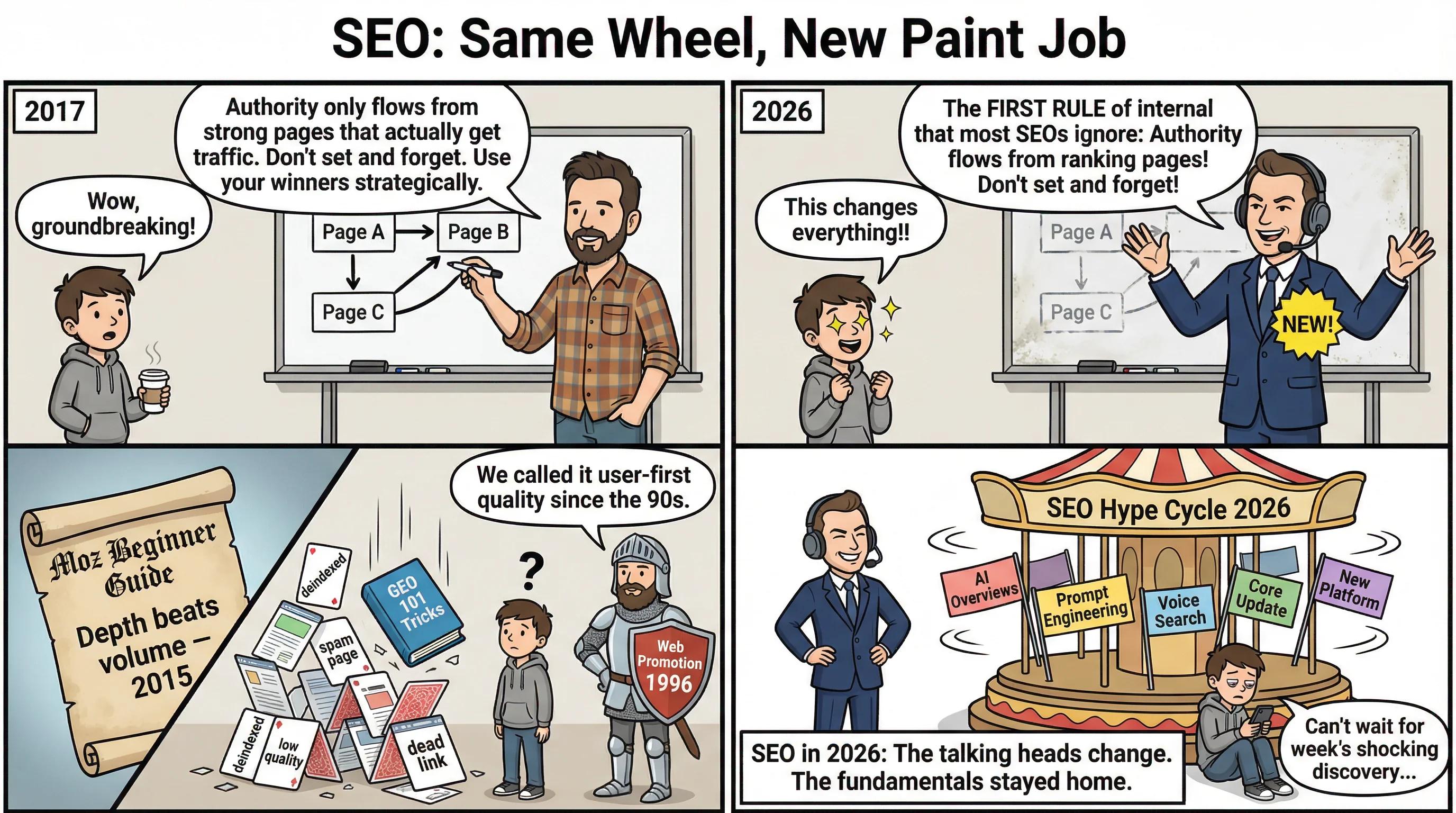
Take internal linking, for example. In 2017, Rand Fishkin stood in front of a whiteboard and explained that internal links only pass real value when they come from pages that actually have authority and traffic. Do not spray them everywhere. Do not treat them as set-and-forget. Use your winners strategically to boost the almost-there pages. Clean up the junk. Keep it sensible.
Fast-forward nine years. A shiny new podcast breathlessly reveals that internal links are not set-and-forget, that authority flows best from ranking pages that get clicks, and that you should use your strong pages to lift the strikers instead of automating everything into oblivion. Groundbreaking stuff. The whiteboard did not move. Only the microphone did.
Quality always beats volume
Consider the revelation that depth and quality of content beat frequency and volume. Back in November 2015, Moz dropped its Beginner's Guide to Content Marketing and made a clear point: produce content at a rate you can actually make excellent. A thousand mediocre posts? You have just wasted a year. Thin, templated, low-effort pages at scale were Panda bait then, and they are a Helpful Content slap now.
Programmatic SEO enthusiasts in 2025 and 2026 learned this the hard way when Google deindexed thousands of their auto-generated pages. The post-mortems acted stunned. Who could have foreseen that depth matters? Moz could, in 2015.
Matching search intent is not a new trick
Search intent gets the same recycled treatment. In September 2020, Moz published a guide on search intent: Google the keyword first. Look at the top results. If they are blogs, build a blog. If they are product or collection pages, build those, or you will never crack the top spots. Match the intent or miss the traffic.
SEO Built specifically for aesthetic clinics — search visibility that attracts the right patients, not just traffic.
Cue 2026. A Shopify SEO expert posts on social media that search intent is the easiest step in SEO and most people still do not take it. Brilliant. Revolutionary. Except it was not new when it was written six years ago, and it certainly was not new when Ammon Johns was discussing intent-driven page building in the mid-2000s.
Ammon Johns, a web promotion pioneer since 1996, was calling it exactly that: web promotion. Focus on the user. Build experiences people actually want. Use links strategically. Add genuine value or do not bother creating the page. Understand the real task behind the query. Quality over quantity. Serve the customer first, and the engines will follow.
While today's LinkedIn warriors frantically invent the first rule of the latest trend, Ammon was quietly teaching the big picture in forums when many of us were still figuring out meta tags.
The E-E-A-T and GEO hype cycles
Then there is E-E-A-T. Genuinely useful for doctors, scientists, academics, and professionals with deep, natural roots in their field. For the rest of us, it is mostly repackaged common sense about building real trustworthiness and expertise. It is the same "be genuinely good at what you do and show it" advice that was obvious in the web promotion days.
And now, the flavour of the month: Generative Engine Optimisation (GEO ). The entire fraternity is buzzing with guides, checklists, and secret tactics to get your brand cited in LLMs, ChatGPT answers, Perplexity results, and Google AI Overviews. Structured data. Statistics. Authoritative citations. Make it AI-readable. 101 tricks to hack the machines.
Strip away the hype, and what do you have? Mostly solid fundamentals: write clear, helpful, structured content that matches intent, cites real sources, and provides actual value. The same things Ammon Johns was advocating decades ago. The house of cards becomes obvious the moment a model updates its policies or training data — poof, half the tricks evaporate.
Focus on what actually matters
This is the modern SEO sector in a nutshell. Little genuine new insight. Endless regurgitation dressed up as innovation. Social platforms that reward drama and teardown over education and uplift. Newcomers get entertained by the spectacle but rarely get the timeless basics: understand your users, build quality experiences, promote honestly, and let real value do the work.
- Understand your users and their intent
- Build quality experiences that answer their questions
- Promote your content honestly
- Let real value drive your visibility
The knowledge has not advanced dramatically in years. The tools have somewhat. The distribution and hype machines certainly have. But the core has been there since pioneers like Ammon Johns were figuring out how to get real traffic before Google even existed as we know it.
If you want actual progress, skip the latest podcast carousel. Go read the old Moz Whiteboard Fridays. Dig into the Cre8asite archives. Listen to the veterans who called it web promotion and meant it. The rest is mostly loud, profitable theatre.
The wheel does not need reinventing. It just needs someone willing to push it in the right direction instead of selling new paint jobs every quarter.