


Programmatic SEO (pSEO) has always been misunderstood. At its core, it was never about "automating content." It was about systematically generating pages from structured data at scale. What is changing now is not the concept itself, but the environment it operates in. Search systems are evolving. Retrieval systems are evolving. And with that, the criteria for what actually gets surfaced, reused, and trusted is evolving too.
The Original Promise of pSEO
Programmatic SEO emerged as a way to scale content production using templates and datasets. It allowed publishers to capture long-tail queries efficiently and build coverage across large combinations of variables, such as locations, products, attributes, and comparisons.
In a traditional search environment, this worked well when queries were keyword-driven and matching was heavily lexical. Repetition and exact phrasing played a larger role in determining relevance. In that context, pSEO functioned as a force multiplier.
Check out the SEO Founders’ User Guide, a resource drawn from the collective experience of the SEO sector. Cut through the chaff and discover your green pastures.
Where pSEO Started to Break Down
As systems like Google improved their understanding of intent and meaning, the limitations of scaled content became more visible. The issue was never scale itself. It was this: scale without incremental value produces noise, not signal.
Data proves this point. A recent 16-month study tracking 2,000 fully AI-generated articles across 20 new domains found that while 71% were quickly indexed and gained early visibility, only 3% of those pages maintained top 100 rankings after three months. Many programmatic pages repeated the same underlying information with minimal variation. They failed to introduce new insight per page and relied on template swapping rather than differentiated substance. As a result, systems became better at detecting redundancy, thin variations, and a lack of informational contribution.
Scale without incremental value produces noise, not signal. Modern systems are far better at distinguishing between the two.
The Shift We Are Now In
We are now moving beyond traditional search into systems that do not just rank pages, but interpret, synthesise, and reuse information directly. This introduces a fundamental shift in how pSEO should be understood. Visibility will shift from ranking #1 to being included in generated answers with traceable influence.
This is not theoretical. Recent network traffic analysis of Google's AI Overviews reveals it uses a completely separate retrieval system from organic search, extracting individual passages and scoring them for relevance in under 200 milliseconds. This means a page ranking #15 organically can earn a citation while the #1 result is ignored. Furthermore, forecasts predict that daily usage of generative AI within search will be 300% more common in 2026.
In this environment, the goal is no longer just to create pages that can rank. It is to create information that can be retrieved, interpreted, and reused within generated outputs.
From Semantic Relevance to Outcome Effectiveness
Historically, optimisation focused on semantic relevance: keyword matching, topical alignment, and on-page signals. That layer still exists, but it is no longer sufficient on its own. Systems are increasingly optimising for outcome effectiveness.
In other words: Does this information help resolve the user's task? Does it contribute to a useful, coherent answer? Does it improve the quality of the final output? This changes how programmatic content is evaluated. It is no longer enough for pages to be "relevant." They must be useful in context of an outcome.
Structure Over Markup, Signals Over Tags
In traditional SEO, schema markup was often treated as a tactical lever. In practise, its value was always indirect. Schema fades as a tactic; structure remains as a requirement. What matters is not the presence of markup alone, but the underlying clarity of entities, consistency of relationships, and organisation of information.
Because modern AI systems use passage-level extraction to build answers, content structured with distinct, self-contained answer blocks inherently has a higher citation surface area. Systems are increasingly capable of inferring structure from content itself. Which means poorly structured content cannot be rescued by markup alone, and well-structured content often does not need heavy reliance on markup. Structure becomes a prerequisite for interpretation, not a shortcut.
Authority Is No Longer Static
Another shift is the way authority is evaluated. In older models, authority was often treated as relatively stable: accumulated links, historical signals, and established domain reputation. In newer systems, authority is becoming more dynamic.
As systems improve, readers are increasingly practising lateral reading to verify sources. Systems mirror this behaviour. Authority becomes time sensitive, not static. This means fresh contributions can influence perception, outdated signals can decay in relevance, and consistency over time matters more than isolated spikes. Authority is no longer just something you "have." It is something that is continuously inferred.
Originality and First-Hand Data
As systems improve, they become better at distinguishing between repackaged information and original contributions. This leads to a clear trend: originality and first-hand data become disproportionately valuable.
Despite the influx of automated content, analysis of 42,000 search results shows Position 1 is still dominated by content featuring original research and human insight. Programmatic SEO, when done well, often sits on top of structured datasets. The differentiator becomes whether that data is unique, whether it provides new insight, and whether it cannot be easily reconstructed elsewhere. Pages that merely rephrase existing information at scale will lose relative value. Pages that introduce proprietary data, unique comparisons, or first-hand analysis will gain increasing advantage.
Identifying True Contribution
As retrieval and synthesis systems improve, they will become more capable of answering a key question: who actually contributed something original? This is not just about content quality in isolation. It is about traceability, consistency across sources, and alignment with other signals in the ecosystem.
Systems will increasingly evaluate not just what is said, but how often and where similar contributions appear. This is where entity-level understanding becomes important. Not pages in isolation, but the entities behind them.
The EEAT Question, Reframed
The debate around EEAT is often framed incorrectly. The question is not: Does EEAT exist? The more relevant question is: What is the minimum set of signals required for a system to confidently reuse your information?
Because that is what modern systems are optimising for: confidence in reuse, reliability of synthesis, and stability of outputs. EEAT, in this context, is not a checklist. It is an emergent property of consistency, credibility, corroboration, and originality over time.
What This Means for Programmatic SEO
Programmatic SEO is not obsolete. But its constraints are clearer than ever. To remain effective, it must evolve from mass page generation into structured, meaningful, differentiated information generation at scale.
That means each page must contribute something non-trivial, reflect a clear intent or use case, and exist for a reason beyond templated variation.
The Direction of Travel
All of these changes point in the same direction:
Visibility will shift from ranking positions to inclusion in generated outputs.
Systems will prioritise outcome effectiveness over pure semantic matching.
Structure will matter more than markup.
Authority will become dynamic and time-sensitive.
Originality and first-hand data will carry increasing weight.
Systems will get better at identifying who actually contributed meaningful information.
Final Thought
Programmatic SEO was built for a world of indexed pages and ranked results. We are moving toward a world of retrieved fragments, synthesised answers, and traceable influence within generated outputs.
The core principle remains the same: scale is only valuable when it produces signal. The difference now is that systems are far better at distinguishing between the two. And that changes everything about how pSEO must be approached going forward.
E-E-A-T in the Age of LLMs: Why Content Features Don't Translate to Trust
The most common misunderstanding about E-E-A-T is also the most consequential. It is not a checklist. It is not a set of content features you add to a page. Yet the industry has largely collapsed it into exactly that.
This matters because as systems shift from ranking pages to retrieving and synthesizing information, the gap between what people think E-E-A-T is and what it actually represents becomes a critical vulnerability.
Why This Diagram Misses the Point
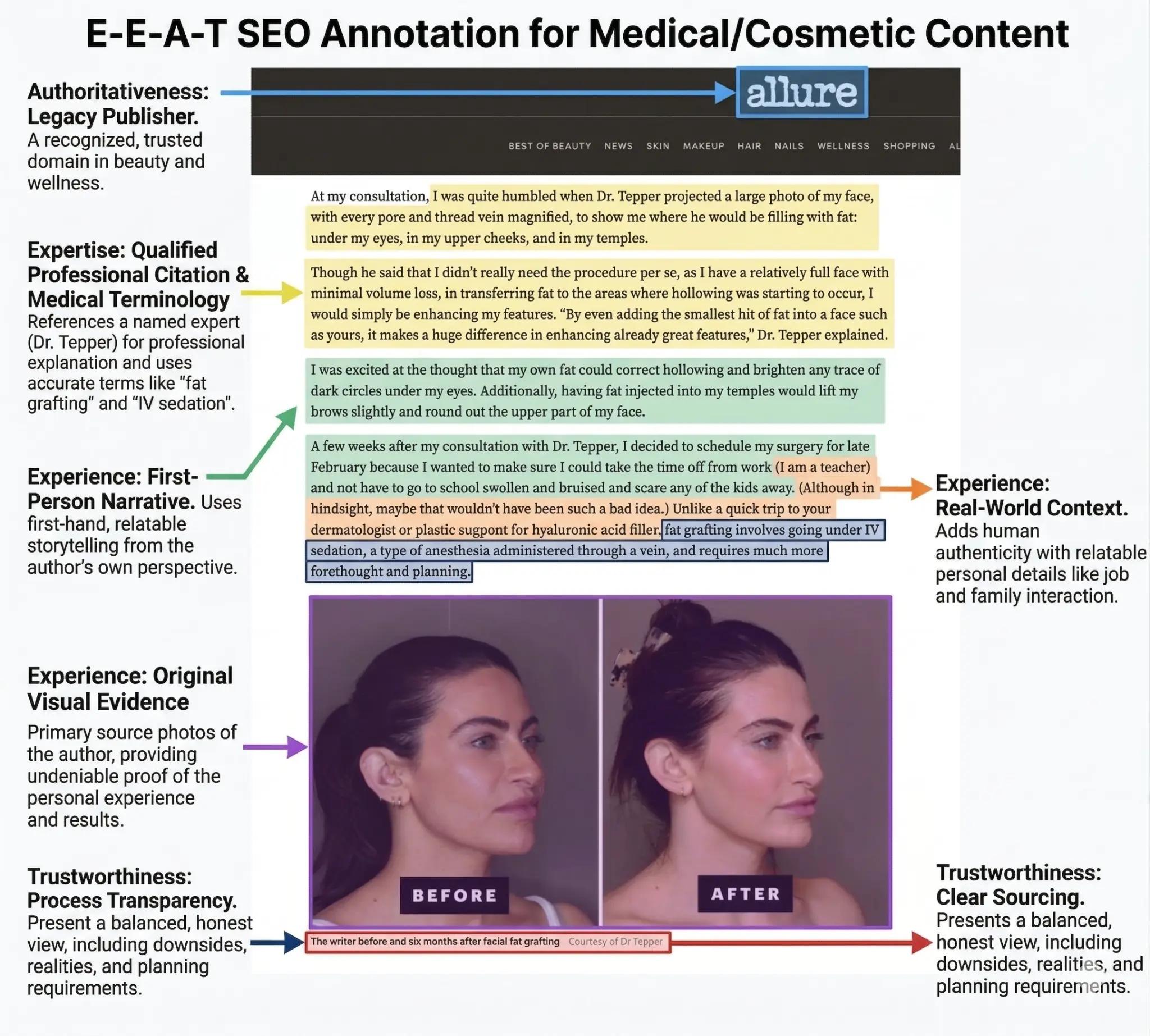
This isn't really how E-E-A-T works.
What you've shown are content features , things that can support perception (first-person narrative, expert quotes, before/after images, etc.) , but E-E-A-T itself isn't something you "add" to a page like annotations.
It's an evaluative framework, not a checklist.
Google doesn't assign "experience" because there's a personal story, or "expertise" because a doctor is quoted. Those elements can help, but they're proxies at best.
Actual E-E-A-T is inferred from a much broader set of signals:
- consistency of quality over time
- reputation beyond the site
- corroboration across sources
- accuracy and alignment with known knowledge
- who is behind the content, not just what's on the page
This kind of diagram risks reducing it to on-page decoration, when in reality it's mostly off-page and longitudinal.
What E-E-A-T Actually Is
E-E-A-T originates from Google's Search Quality Rater Guidelines. It is an evaluative framework used by human raters to assess whether a source would be trusted outside of search. The question it attempts to answer is straightforward: Would this source be trusted in the real world?
That means E-E-A-T is fundamentally rooted in signals that exist independently of any webpage:
- Real-world reputation
- Verifiable expertise
- Independent validation
- Historical consistency
- External corroboration
Not in:
- On-page formatting
- Self-declared credentials
- Trust badges
- Author bios
- Schema markup
This distinction is critical because it reveals the core problem: the strongest E-E-A-T signals are precisely the ones that large language models are worst equipped to verify.
The Real Model: Mr Richard Hanson, MB, MCh, FRCS (Plast)
Consider a real-world professional: Mr Richard Hanson, MB, MCh, FRCS (Plast) , an Irish plastic surgeon with genuine, verifiable credentials. His authority cannot be easily faked because it is grounded in verifiable, external systems.
His trust signals exist in places like:
- Medical registries (General Medical Council, Irish Medical Council)
- Hospital affiliations and surgical privileges
- Research publications in peer-reviewed journals
- Conference participation and speaking engagements
- Peer recognition and professional recommendations
- Independent patient reviews and documented outcomes
These signals are:
- External to any webpage he might create
- Verifiable through independent systems
- Accumulated over time and difficult to manipulate
- Rooted in institutional validation
This is genuine E-E-A-T substrate.
Now contrast this with how the SEO industry typically approaches E-E-A-T. The standard playbook is: add an author bio, display credentials prominently, include trust badges, apply schema markup, use professional photography. This creates a dangerous simplification: presentation of trust gets confused with evidence of trust.
Two websites can look nearly identical on the surface. One represents real authority backed by external validation. The other imitates it through presentation alone. But underneath, one has genuine institutional backing and the other has self-assertion. E-E-A-T exists in that difference.
What E-E-A-T Actually Is
E-E-A-T originates from Google's Search Quality Rater Guidelines. It is an evaluative framework used by human raters to assess whether a source would be trusted outside of search. The question it attempts to answer is straightforward: Would this source be trusted in the real world?
That means E-E-A-T is fundamentally rooted in signals that exist independently of any webpage:
- Real-world reputation
- Verifiable expertise
- Independent validation
- Historical consistency
- External corroboration
Not in:
- On-page formatting
- Self-declared credentials
- Trust badges
- Author bios
- Schema markup
This distinction is critical because it reveals the core problem: the strongest E-E-A-T signals are precisely the ones that large language models are worst equipped to verify.
The Surgeon Model: Where E-E-A-T Becomes Obvious
Consider a real-world professional: a surgeon with credentials such as MB, MCh, FRCS (Plast). Their authority cannot be easily faked because it is grounded in verifiable, external systems.
Their trust signals exist in places like:
- Medical registries (General Medical Council, Irish Medical Council)
- Hospital affiliations and privileges
- Research publications in peer-reviewed journals
- Conference participation and speaking engagements
- Peer recognition and recommendations
- Independent patient reviews and outcomes
These signals are:
- External to any webpage they might create
- Verifiable through independent systems
- Accumulated over time and difficult to manipulate
- Rooted in institutional validation
This is genuine E-E-A-T substrate.
Now contrast this with how the SEO industry typically approaches E-E-A-T. The standard playbook is:
- Add an author bio
- Display credentials prominently
- Include trust badges
- Apply schema markup
- Use professional photography
This creates a dangerous simplification: presentation of trust gets confused with evidence of trust.
Two websites can look nearly identical on the surface. One represents real authority backed by external validation. The other imitates it through presentation alone. But underneath, one has genuine institutional backing and the other has self-assertion. E-E-A-T exists in that difference.
The LLM Problem: Text Representations, Not Reality
Large language models operate under a fundamental constraint that makes E-E-A-T verification nearly impossible.
LLMs do not:
- Query live registries to verify credentials
- Maintain persistent, trusted identity graphs
- Access real-time institutional databases
- Verify professional affiliations independently
Instead, they operate on:
- Text corpora from training data
- Statistical patterns in language
- Learned relationships between concepts
- Frequency of mention across sources
This creates a structural mismatch. E-E-A-T is strongest when it is grounded in reality,external, hard to fake, independently validated. LLMs only see representations of those things in text form.
For a surgeon, this means:
- A genuine medical profile from a verified registry
- A well-written affiliate page claiming expertise
Can look structurally similar when reduced to text. The model sees patterns and language consistency but cannot access the underlying verification system that distinguishes one from the other.
The Fallback: Frequency Becomes Authority
When models cannot verify truth directly, they default to proxies. And those proxies often correlate with something very different from actual expertise.
When LLMs encounter conflicting or unverifiable information, they rely on:
- Frequency of mention across sources
- Consistency across indexed content
- Prominence in training data
- Prevalence in high-ranking pages
Which often means:
- Widely cited industry content
- Repeated narratives in SEO-driven sites
- Content that ranks well in Google
- Aggregated publisher perspectives
This creates a substitution: "widely said" becomes "likely true".
This is not a bug in LLM design. It is a rational fallback when ground truth cannot be accessed. But it creates a reinforcing cycle.
The 2026 Evidence: How LLMs Cite Blog Consensus Over Expertise
This pattern is not theoretical. March and April 2026 studies provide concrete evidence of exactly how this mechanism operates in real time.
Example 1: Ranking Factors Query
When major models (ChatGPT, Gemini, Perplexity, and others) are asked "What are the most important ranking factors for Google in 2026?", they overwhelmingly cite popular SEO blogs and listicles that currently rank in Google's top 10–20. These include articles from Ahrefs, SEMrush, Search Engine Journal, and well-known "best of" guides. The models repeat claims like "EEAT is now the #1 factor" or "focus on topical authority clusters",phrases that have become content consensus precisely because they rank well.
But what the models actually do, according to March 2026 studies, reveals the mechanism:
- GPT-5.3 still sends approximately 32% of citations to blog posts for non-branded SEO queries
- Pages with high referring domains (i.e., Google authority signals) are 3.5× more likely to be cited than lower-authority pages
- Real veteran practitioners with 20+ years of documented results and zero hype often get ignored unless their content also matches the "popular blog" style and ranks well
The model is not evaluating first-hand experience or long-term survival through updates. It is using Google ranking plus consensus as a shortcut for "truth."
Example 2: Helpful Content Update Query
When asked "How has Google's Helpful Content Update changed SEO strategy?", LLMs consistently regurgitate the narrative from the highest-ranking blog posts,many of which were written shortly after each update by agencies chasing traffic.
The real pattern from 2026 data:
- Only approximately 38% of pages cited in Google AI Overviews (and similar LLM answers) even rank in the top 10 for the query
- Yet models still heavily favour listicles, "ultimate guides," and opinion-heavy blogs that dominate current SERPs
- Citation velocity and "content-answer fit" (how closely the page mirrors how the LLM itself writes) matter far more than demonstrated real-world experience or survival through multiple HCU or core updates
In short: If it ranks well on Google, LLMs treat it as authoritative, even if the author has never run a large-scale campaign or survived the updates they are writing about.
The Feedback Loop: Search Visibility Becomes Perceived Authority
There is a compounding effect between search ranking and LLM training:
1. Google ranks content based on its algorithm
2. That content becomes highly visible and indexed
3. It is included prominently in training data for LLMs
4. LLMs reproduce those patterns and perspectives
5. Users consume and reinforce those narratives
The result: search visibility → training prominence → perceived authority
Not necessarily actual expertise.
This is particularly problematic because it means content that ranks well in Google,for whatever reason,gains a secondary advantage: it becomes more likely to be reproduced by LLMs, which further amplifies its perceived authority.
A page that ranks #1 for a query is more likely to be in training data. A page in training data is more likely to be referenced by an LLM. A page referenced by an LLM gains credibility through association with the model's output.
This creates a compounding visibility advantage that has nothing to do with actual expertise or real-world authority.
Why LLMs Cannot Distinguish Real Authority from Claimed Authority
LLMs struggle to reliably differentiate between:
- Self-declared expertise
- Independently validated expertise
They process:
- "World-renowned expert"
- "20 years of experience"
- "Certified professional"
But cannot inherently verify:
- Is this registered anywhere?
- Is this corroborated by external sources?
- Is this reputation earned or simply claimed?
So they treat both as similar signals in text space.
There is another structural issue: LLMs are trained heavily on publishers, SEO-driven sites, aggregated content, and media platforms. They are trained less directly on practitioners themselves.
This means LLMs often "know":
- What is written about experts
- Better than the experts themselves
This shifts perceived authority toward content producers and publishers, not domain authorities. A well-written article about a surgeon can rank higher in LLM outputs than the surgeon's own professional profile.
The Content Features Trap: Why Annotations Don't Create E-E-A-T
This brings us back to the diagram that prompted this analysis. The image shows content features,first-person narrative, expert quotes, before/after images, professional photography,and labels them as E-E-A-T signals.
These are not E-E-A-T. They are content features that can support perception of E-E-A-T. But they do not create it.
The distinction matters because:
- Content features are easy to replicate
- Real E-E-A-T signals are difficult to fake
- LLMs can process features
- LLMs cannot verify the reality behind them
A well-optimised page with professional photography, expert quotes, and a polished author bio might look authoritative. But if that authority is not grounded in real-world verification systems, it is presentation without substance.
For an LLM, this creates a problem: it cannot tell the difference. So it defaults to treating both as similar signals.
Why E-E-A-T Is Fundamentally Anti-Textual
This is the key insight: the strongest E-E-A-T signals are the ones that exist outside of text.
The most important trust signals are:
- Off-page signals (links, mentions, citations)
- Real-world reputation (professional registries, institutional affiliations)
- Historical consistency (track record over time)
- Independent validation (peer review, external corroboration)
- Longitudinal signals (sustained authority, not spikes)
LLMs are strongest at:
- Processing text
- Generating language
- Finding patterns in corpora
- Reproducing learned relationships
So: the most important trust signals are the ones LLMs are worst at accessing.
The result is fluent but not grounded. LLMs can produce confident, well-written answers that are based on consensus rather than truth. They can synthesize widely accepted narratives without verifying them. They can sound authoritative while being slightly off or overgeneralized.
This is why you see LLMs confidently providing information that is:
- Slightly inaccurate
- Overgeneralized
- Based on what is widely said rather than what is true
- Influenced by search ranking rather than expertise
The Correct Mental Model
E-E-A-T does not work like this:
Add signals → gain trust → rank
It works like this:
Be trusted in reality → signals emerge → systems detect them → visibility follows
The direction matters. You cannot add E-E-A-T to a page. You can only build the real-world foundation that causes E-E-A-T signals to emerge.
For a surgeon, this means:
- Maintain credentials and registrations
- Publish in peer-reviewed journals
- Speak at conferences
- Build reputation through outcomes
- Accumulate independent mentions and citations
For a publisher or content creator, this means:
- Produce consistently accurate, original information
- Build reputation through corroboration and citation
- Maintain consistency over time
- Contribute unique insights that cannot be easily reconstructed
- Earn mentions and links from authoritative sources
These are not tactics. They are the foundation upon which authority is built.
The Implication for Programmatic SEO
This creates a specific challenge for programmatic SEO in the LLM era.
Programmatic content at scale can only remain effective if it introduces genuine value per page. Content that merely repackages existing information with template variation will lose relative advantage because:
1. LLMs can identify redundancy across sources
2. Systems reward originality and first-hand data
3. Authority is increasingly tied to unique contribution, not just presence
But programmatic content that is built on structured, original datasets,unique comparisons, proprietary analysis, first-hand research,can gain advantage because:
1. It cannot be easily reconstructed elsewhere
2. It introduces information that systems cannot find in other sources
3. It creates a reason for citation and inclusion in generated outputs
The difference is not scale. It is whether that scale produces signal or noise.
Final Thought
LLMs are not "wrong" about E-E-A-T because they are poorly designed. They struggle because E-E-A-T is grounded in real-world verification systems and LLMs operate on statistical representations of text.
So they compensate by leaning on frequency, visibility, consensus, and search-influenced content. Which leads to outputs that reflect the web as it is indexed and ranked, rather than reality itself.
Understanding this gap is critical for anyone building content strategy in an LLM-influenced search environment. The most effective approach is not to optimise for how LLMs perceive authority. It is to build actual authority and let the signals emerge naturally.